How to invest for different financial goals in Kenya is not a one-size-fits-all question, because the way you invest for retirement should look very different from how you invest to pay next year's school fees. Many Kenyans lose money because they put short-term money into long-term investments, or long-term money into places that pay very little. This guide breaks it down goal by goal, so you can build a plan that actually fits your life.
It means matching each goal to the right investment type. Short-term goals (under 3 years) suit money market funds and fixed deposits. Medium-term goals (3–7 years) suit unit trusts and Saccos. Long-term goals (7+ years) suit shares, bonds, and real estate for stronger growth.

Why Your Financial Goal Should Decide Your Investment
Before you invest a single shilling, ask yourself one question: what am I saving this money for, and when will I need it? A goal that is 20 years away, like retirement, can handle more risk, because there is time to recover from a bad year. A goal that is 6 months away, like a wedding, cannot handle risk at all, because you need that money to be there, in full, on the day you need it.
Kenya's investing world offers plenty of choices — Saccos, money market funds, unit trusts, Treasury bonds, Treasury bills, shares on the Nairobi Securities Exchange, and real estate. If you want a wider view of what is available before picking your goal-based strategy, our guide on the best investment options in Kenya is a good place to start.
If the NSE specifically is your main interest, our companion guide on building wealth through the NSE in Kenya goes much deeper into shares, dividends, and compounding.
Investing for Retirement in Kenya
Investing for retirement works best when you start early and stay consistent, because of the power of compound growth over many years. Most employed Kenyans already contribute to NSSF, but this alone is rarely enough to retire comfortably, so a second layer of saving matters.
How to Build a Retirement Plan
- Join a registered pension scheme or a personal retirement plan through an insurance company or fund manager.
- Add long-term shares on the NSE for companies that pay steady dividends, such as banks and telecoms.
- Consider Treasury bonds for a stable, government-backed portion of your retirement portfolio.
Dividend-paying shares are a favourite for Kenyan retirement investors because they create an income stream. Our breakdown of the Safaricom dividend payout to investors through the years shows how consistent dividends can support a retirement plan over decades.
To organize your retirement holdings properly rather than buying shares one at a time, see our guide on how to build an investment portfolio in Kenya, and for later-stage tactics, advanced investing strategies for experienced Kenyan investors.
Investing for Children's Education
Investing for children's education needs a plan that grows with your child, since fees rise every year and university costs come with a big lump sum at the end. The earlier you start, the smaller your monthly contribution needs to be.
A Simple Education Investment Ladder
Many parents also add NSE shares to this plan for extra long-term growth. If shares are part of your education fund strategy, learning how to analyze stocks before buying in Kenya will help you pick stronger companies. If shares are part of the plan, our shortlist of 10 best shares to buy in Kenya is a useful starting point for research.
Investing to Buy a Home
Investing to buy a home in Kenya usually means saving a deposit first, since most banks and Saccos require between 10% and 20% of the property value upfront. This is a medium-term goal for most people, so safety matters more than chasing high returns.
Best Ways to Save for a Home Deposit
- Money market funds for flexible, low-risk saving with better interest than a regular bank account.
- Sacco deposits, which often unlock affordable mortgage products once you have saved consistently.
- Treasury bonds for a fixed return if your home purchase is more than 2 years away.
Location matters just as much as the deposit. If you are still deciding where to buy, our guide on the best neighborhoods in Nairobi for young professionals is a helpful starting point, and land outside the city, such as our feature on investing in Laikipia County, shows how real estate opportunities differ across Kenya.
If you're saving the deposit itself rather than deciding where to buy, our guide on how to invest at every income level in Kenya shows realistic savings paths at different budgets.
Investing for Passive Income
Investing for passive income means choosing investments that pay you regularly, without you having to work for that money every month. This is popular with Kenyans who want extra income alongside a salary or business.
Top Passive Income Investments in Kenya
| Investment | Typical Payout | Best For |
|---|---|---|
| Dividend-paying NSE shares | Annually or semi-annually | Long-term passive investors |
| Treasury bonds | Every 6 months | Investors who want fixed, predictable income |
| Rental property | Monthly | Investors with larger capital |
| Money market funds | Daily accrual, monthly payout option | Investors who want flexibility |
To see how dividend income actually looks in practice, check our full history on the Equity Bank dividend payout and how to invest, which is one of the most consistent passive income shares on the NSE.
Once you're ready to act, our step-by-step guide to buying shares in Kenya walks you through opening a CDS account and placing your first order.
Ready to buy shares or bonds?
If dividend shares or Treasury bonds are part of your plan, you need a licensed stockbroker to open your CDS account and place your orders safely.
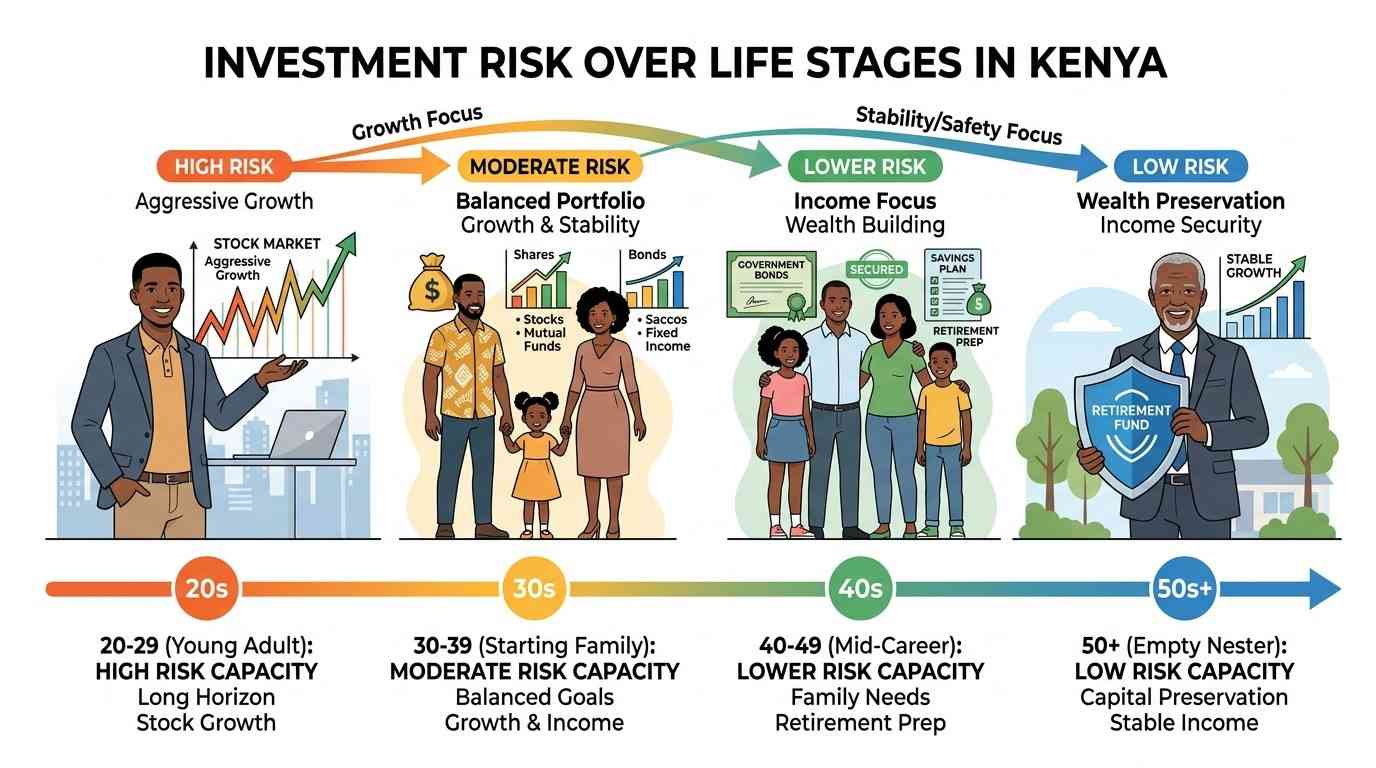
Investing by Age: 20s, 30s, 40s, and 50s
Your age plays a big role in how much risk you can afford to take, because it decides how much time your money has to recover from ups and downs.
Investing in Your 20s
Investing in your 20s is the best time to take on more risk, because retirement is still 30 to 40 years away. Put a bigger share of your money into NSE shares and unit trusts, and use this decade to build strong saving habits.
Investing in Your 30s
Investing in your 30s often means juggling more goals at once — a young family, a house deposit, and career growth. A balanced mix of shares, unit trusts, and a home savings plan works well here.
Investing After Age 40
Investing after age 40 calls for a shift toward more stability, since retirement is now within 15 to 25 years. Start increasing your allocation to bonds and dividend shares while still keeping some shares for growth.
Investing in Your 50s
Investing in your 50s should focus heavily on protecting what you have already built. Move a larger share of your portfolio into Treasury bonds, money market funds, and stable dividend shares, since there is less time to recover from a market downturn before retirement.
Whatever your age, it helps to start from the same foundation — our personal finance basics every Kenyan investor should know guide covers the habits that make every strategy above actually work.
Investing as a Newly Married Couple
Investing as a newly married couple works best when both partners agree on shared goals early, such as a home, children's education, or a family emergency fund. Open communication about money prevents most of the conflict that new couples face.
Steps for Couples Starting Out
- List your combined goals and rank them by priority and time frame.
- Open a joint money market fund or Sacco account for shared short-term goals.
- Keep some individual investments too, so each partner still has personal financial independence.
If retirement planning is one of your shared goals, it helps to understand common pitfalls first. Our guide on 20 investing myths that cost Kenyans money is a good read for couples building their first joint plan together.
Investment Planning for Families
Investment planning for families means balancing several goals at the same time — school fees, a home, an emergency fund, and eventually retirement. The trick is to give each goal its own "bucket" instead of mixing all your money together.
| Bucket | Share of Investable Income |
|---|---|
| Medium-term goals (school fees, home) | 40% |
| Long-term retirement investing | 30% |
| Emergency fund | 20% |
| Flexible / passive income | 10% |
Families who want a broader view of sector opportunities in Kenya, from banking to manufacturing, can explore our guide on the best sectors to invest in Kenya to diversify a family portfolio. For a fuller view of how much to allocate at each family income level, see how to invest at every income level in Kenya.
Investment Planning for Freelancers
Investment planning for freelancers is trickier than for employed Kenyans, because income is not fixed every month. Freelancers do not get NSSF contributions automatically, so building a personal retirement and safety net is even more important.
What Freelancers Should Prioritize
- Build a bigger emergency fund than employed workers, since income can be unpredictable.
- Open a personal pension plan, since there is no employer contribution to rely on.
- Use money market funds to save a portion of every payment received, so investing does not depend on remembering to do it monthly.
Freelancers who are still growing their income streams may also find value in reviewing common risks of investing in the NSE in Kenya for beginners before committing savings to shares. As a Freelancer investing in NSE shares, you should also understand the regulations that protect Kenyan shareholders before committing irregular income to the market.
Investment Planning for Business Owners
Investment planning for business owners should always separate personal wealth from business capital, because reinvesting every shilling back into the business creates risk if that business ever struggles. A business owner needs personal investments outside the business too.
Key Principles for Business Owners
- Pay yourself a consistent amount and invest part of it outside the business, in shares, bonds, or unit trusts.
- Avoid keeping all your wealth tied up in business assets or stock.
- Use dividend shares and Treasury bonds to build a personal income stream that does not depend on the business performing well.
Business owners who want quick answers on getting started with the stock market can also read our roundup of questions on investing in Kenya & answers. Those ready to build a serious personal portfolio outside the business should read our advanced investing strategies for experienced Kenyan investors.
Common Mistakes to Avoid
- Ignoring your time frame: putting short-term money into shares that can fall in value right before you need the cash.
- No emergency fund: being forced to sell long-term investments early because of an unplanned expense.
- Chasing hype: investing in a stock or scheme simply because everyone is talking about it, without checking the fundamentals.
- Not diversifying: putting all your money into one company, one sector, or one Sacco.
For a fuller list of proven approaches instead of the common traps above, see our 12 proven investment strategies that work in Kenya. And before chasing a "hot" stock, check whether it's actually fairly priced with our guide on how to spot overvalued vs undervalued stocks in Kenya.
Frequently Asked Questions
How much money do I need to start investing in Kenya?
You can start investing in Kenya with as little as Ksh 500 through a money market fund or Sacco. Shares on the NSE can be bought with a few thousand shillings through a licensed stockbroker.
What is the best investment for a short-term goal in Kenya?
Money market funds and fixed deposit accounts are best for short-term goals in Kenya because they protect your capital and pay interest while keeping your money easy to withdraw.
Should I invest differently depending on my age?
Yes. Younger investors in their 20s and 30s can take more risk in shares and unit trusts, while investors nearing 50 and beyond should shift more money into safer options like bonds and money market funds.
Is it better to invest as a couple or individually?
Newly married couples in Kenya often build wealth faster by combining goals into a joint plan, such as a joint Sacco account or joint unit trust, while still keeping some individual investments.
How do I buy shares on the Nairobi Securities Exchange?
To buy shares on the NSE, open a CDS account through a licensed stockbroker such as Faida Investment Bank, deposit funds, and place a buy order for the company shares you want.
Final Thoughts
Knowing how to invest for different financial goals in Kenya comes down to one simple habit: matching your money to your timeline. Short-term goals need safety, medium-term goals need a balance, and long-term goals like retirement can take on more growth-focused investments. Start with one goal, pick the right tool for it, and build from there.