The biggest risks of investing in the NSE are more serious than most beginners realise, and they can cost you real money if you don't prepare. The good news is that these risks are manageable — and once you understand them, you can protect your savings and build wealth on the Nairobi Securities Exchange with confidence.
Thousands of Kenyans open CDS accounts every year hoping to grow their money through shares. But many end up losing money — not because the stock market is rigged, but because they didn't understand the dangers before jumping in. This guide breaks down every major risk in plain English, explains why beginner investors keep making the same mistakes, and shows you exactly what to do instead.
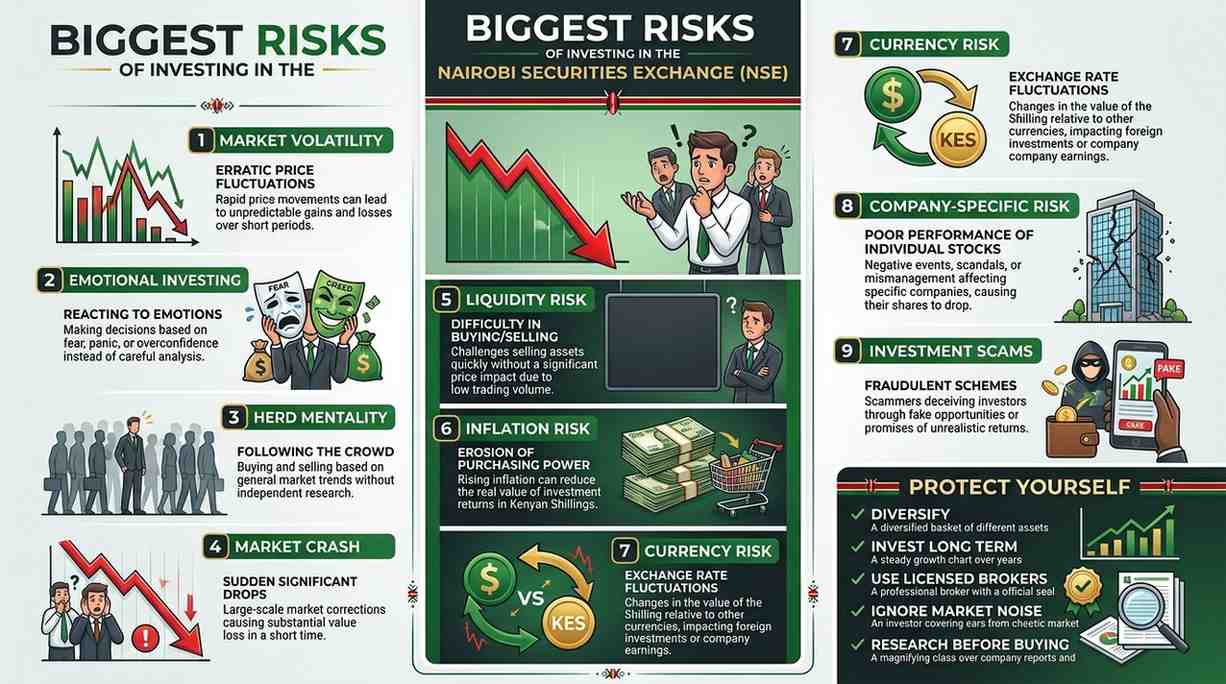
1. Market Volatility: Prices Go Up AND Down
Share prices on the NSE do not move in a straight line. One day, Safaricom shares might be trading at Ksh 16. Three months later, they might be at Ksh 12. This up-and-down movement is called market volatility, and it is the most basic risk every investor faces.
Volatility happens because the price of a share is driven by what millions of buyers and sellers agree it is worth at any given moment. News events, company results, interest rate changes, elections, global oil prices — all of these things push share prices higher or lower, sometimes within hours.
Market Volatility Risk
Share prices can fall by 20%–50% during periods of economic stress. The NSE 20 Share Index dropped significantly during the 2008 global financial crisis and again during the COVID-19 pandemic in 2020. Short-term investors who needed their money during those periods had to sell at a loss.
What to do: Only invest money you don't need for at least three to five years. If you might need the money next month to pay rent or school fees, the stock market is the wrong place for it.
2. Emotional Investing: How Fear and Greed Destroy Wealth
Emotional investing is one of the most dangerous forces on the stock market — and most people don't even realise they are doing it. It happens when you make investment decisions based on how you feel rather than what the facts tell you.
There are two main emotions that drive bad investment decisions: fear and greed.
The Fear Trap
When share prices start falling, fear kicks in. You start thinking, "What if I lose everything?" So you sell your shares — often at the worst possible time, locking in a loss. Then, a few weeks later, prices recover and you watch other investors make money from shares you just sold.
The Greed Trap
When share prices are rising fast and everyone is talking about how much money they are making, greed kicks in. You rush to buy without doing any research — often at the peak of the price. Then the price falls back down and you are left holding shares worth less than what you paid.
This pattern is so common there is even a name for it: investors buy high and sell low — the exact opposite of what they should be doing. Studies of investor behaviour globally show that the average retail investor earns far less than the market average, mainly because of emotional decisions.
3. Why Beginners Lose Money in Stocks
New investors on the NSE tend to repeat the same costly mistakes. Here are the most common ones:
- No research: Buying shares based on a friend's tip or a WhatsApp message without checking the company's financial results.
- No diversification: Putting all your money into one or two shares. If one company crashes, you lose everything.
- Timing the market: Trying to predict when prices will go up or down. Even professional fund managers get this wrong most of the time.
- Ignoring transaction costs: Every time you buy or sell shares on the NSE, you pay brokerage fees, CDS levies, and other charges. Frequent trading eats into your returns.
- Investing borrowed money: Using a loan or credit to invest in shares is extremely dangerous. If prices fall, you still owe the loan.
- Chasing dividends blindly: A high dividend is attractive, but if the company is in trouble, it can cut its dividend at any time.
- No exit plan: Many beginners buy shares but never decide in advance at what point they will sell — whether to take a profit or cut a loss.
Understanding how dividends work on the NSE is an important first step before you invest in income-generating shares. Our free NSE Dividend Calculator helps you estimate what you could earn from the top listed companies.
4. Herd Mentality, Social Media & Investment Hype on the NSE
Herd mentality means doing what everyone else is doing, simply because everyone else is doing it. On the NSE, this looks like rushing to buy a share just because it appeared in a trending Facebook post or a YouTube video saying it is "about to explode."
How Social Media Affects Investing Decisions
Social media has made it easier than ever for investment hype to spread. A single viral post claiming that a particular NSE stock is about to triple in value can cause hundreds of people to buy that stock at once — pushing the price up artificially. The people who started the hype then sell at the high price, and when the artificial demand disappears, the price crashes back down. Late buyers are left with losses.
This is sometimes called a "pump and dump" scheme, and it is illegal — but it still happens, especially in less regulated online spaces.
The Danger of Following Investment Hype
Investment hype often focuses on short-term price movements rather than the real value of a business. A company that is genuinely worth investing in will show consistent revenue growth, manageable debt, a clear business plan, and a good dividend history. You won't find that kind of information in a WhatsApp voice note.
5. What Happens During a Market Crash?
A market crash is when share prices fall sharply and quickly — sometimes by 20% or more within a short period. Market crashes are scary, but they are also a normal part of how stock markets work. Every major stock market in the world has experienced multiple crashes.
On the NSE, significant price drops have happened because of:
- Global events like the 2008 financial crisis and the 2020 COVID-19 pandemic
- Local political uncertainty, including election periods
- Currency depreciation (the weakening of the Kenyan shilling)
- Rising interest rates, which make bonds more attractive than shares
- Company scandals or poor financial results
What Should You Do in a Crash?
The worst thing you can do during a market crash is panic and sell. History shows that markets recover over time. Investors who sold their NSE shares at the bottom of the COVID-19 crash in 2020 missed the recovery that followed. Those who held on — or even bought more at the lower prices — came out ahead.
Ready to Start Investing on the NSE the Right Way?
Work with a licensed broker who can guide you through the risks. Faida Investment Bank is a CMA-regulated NSE broker offering professional investment advice for Kenyan investors.
Open an Account with Faida Investment Bank →6. Can You Lose All Your Money in Stocks?
Yes — in the worst case scenario, you can lose all the money you put into a particular share. This happens when a company goes bankrupt and is delisted from the NSE. When a company is delisted, its shares become worthless and you get nothing back.
However, this is rare for blue-chip companies (large, well-established businesses) listed on the NSE. The chance of Safaricom, Equity Bank, or KCB going completely bankrupt is very low. The risk is much higher for smaller, less established companies.
More commonly, investors "lose" money in a different way: they buy shares at Ksh 20, watch the price fall to Ksh 12, and then sell in a panic — turning a temporary paper loss into a permanent real loss. If they had waited, the price might have recovered to Ksh 25.
| Type of Loss | Cause | Can You Recover? | Risk Level |
|---|---|---|---|
| Paper loss (unrealised) | Price falls below what you paid | Yes, if you hold and price recovers | Medium |
| Realised loss | You sell shares below your buy price | No — loss is permanent | High |
| Total loss | Company goes bankrupt / delisted | Rarely | Very High |
| Dividend cut | Company stops paying dividends | Yes — share price may still rise | Medium |
| Inflation loss | Returns lower than inflation rate | Partially — switch to better stocks | Lower |
7. Liquidity Risk: What If You Can't Sell?
Liquidity refers to how quickly you can sell your shares and get your money back. On the NSE, some shares are bought and sold thousands of times every day (highly liquid). Others may go days or even weeks without a single trade (illiquid).
If you hold shares in a company that very few people want to buy, you might find yourself stuck. You want to sell, but there are no buyers at a price you are willing to accept. You might have to drop your price significantly just to find a buyer — resulting in a larger loss than expected.
Liquidity Risk
Stick to the most actively traded shares on the NSE — Safaricom (SCOM), Equity Group (EQTY), KCB Group (KCB), NCBA, Co-operative Bank (COOP), and Bamburi Cement are among the most liquid. Avoid putting large amounts of money into shares with very low daily trading volumes.
8. Inflation & Currency Risk
Even if your share portfolio grows in value, you can still end up poorer in real terms if inflation rises faster than your returns. For example, if your NSE portfolio returns 8% in a year but Kenya's inflation rate is 9%, your actual purchasing power has decreased — even though your account shows a gain.
Currency risk is a separate but related issue. If you invest in a company that earns much of its income in foreign currency (like US dollars), a strengthening Kenyan shilling can reduce the value of those foreign earnings when converted back to Ksh. The reverse is also true — companies that import raw materials in dollars suffer when the shilling weakens.
9. How to Avoid Investment Scams in Kenya
Investment scams are a major and growing problem in Kenya. Fraudsters promise huge returns — sometimes 30%, 50%, or even 100% per month — through fake investment platforms, pyramid schemes, and unlicensed brokers. Every year, Kenyans lose hundreds of millions of shillings to these scams.
Common Signs of an Investment Scam
- Guaranteed returns: No legitimate investment can guarantee returns. Stock markets go up and down — anyone promising you will definitely make money is lying.
- Pressure to decide fast: "This offer closes tonight" or "Only 5 spots left" — these are manipulation tactics designed to prevent you from doing your research.
- No CMA licence: All legitimate investment brokers in Kenya must be licensed by the Capital Markets Authority (CMA). You can verify a broker's licence on the CMA website for free.
- Referral bonuses: If a scheme pays you more for recruiting friends than for actual investment returns, it is likely a pyramid scheme.
- Anonymous operators: Legitimate investment companies have physical offices, registered directors, and public contact information.
- Only on WhatsApp or Telegram: Serious investment firms do not conduct business exclusively through messaging apps.
10. Company-Specific Risk: When a Business Fails
Even if the overall market is doing well, individual companies can struggle or even collapse. A company might report poor financial results, face a major lawsuit, lose a key contract, or suffer a management scandal. All of these events can cause its share price to fall sharply — even if other shares are rising.
This is why diversification — spreading your investment across several different companies and sectors — is one of the most important rules of investing. If you own shares in 10 different companies and one of them collapses, you lose only a tenth of your portfolio. If you owned shares in only that one company, you lose everything.
On the NSE, you can diversify across banking, telecoms, manufacturing, energy, insurance, and real estate sectors. Equity Bank and Safaricom have long dividend track records, making them popular anchors in a diversified Kenyan portfolio.
11. How to Manage Risk When Investing in the NSE
Risk cannot be eliminated entirely — but it can be managed. Here are the most effective strategies used by experienced investors on the NSE:
Practical Ways to Protect Your Investment
- Diversify: Own shares in at least 5–10 different companies across different sectors.
- Invest only what you can afford to lock away: Think of your stock market money as a 5-year minimum commitment.
- Use a licensed broker: A professional broker like Faida Investment Bank can help you build a suitable portfolio based on your goals.
- Invest regularly (dollar-cost averaging): Put a fixed amount into shares every month regardless of price. This smooths out the effect of volatility over time.
- Read the annual reports: Before buying any share, look at the company's revenue, profit, debt, and dividend history.
- Set a stop-loss in your mind: Decide in advance how much you are willing to lose on any single stock (e.g. 25%) before you sell.
- Ignore short-term noise: Don't check prices every day. Develop the habit of reviewing your portfolio quarterly instead.
If you are just starting out in investing, it also helps to understand the wider financial landscape in Kenya. Learn how the Central Bank of Kenya influences interest rates — because CBK rate decisions directly affect NSE share prices, especially bank stocks.
Invest Smarter with a Licensed NSE Broker
Faida Investment Bank is a CMA-regulated stockbroker that helps Kenyans buy and sell NSE shares safely. Whether you are a first-time investor or an experienced one, their team provides expert guidance tailored to your financial goals.
Get Started with Faida Investment Bank →12. Why Patience Is the Most Important Investing Skill
If there is one thing that separates successful investors from those who lose money, it is patience. The stock market rewards people who can hold their investments through the uncomfortable periods of falling prices and uncertainty.
The NSE's best-performing shares have delivered strong long-term returns for investors who held them for 5, 10, or 20 years. But many of those same shares went through painful drops along the way. The investors who held on through the drops are the ones who benefited from the eventual recovery.
Patience also means resisting the urge to chase every new investment trend or "hot stock" you see on social media. The people promoting those trends are often selling to you, not advising you. Long-term wealth on the NSE comes from buying good businesses at fair prices and holding them for years — not from trying to get rich in three months.
This same principle applies whether you are investing in shares, farming, or any other Kenyan business. You can read our broader guide on investment and business opportunities in Kenya to see where else patient capital can work for you.
Looking for a Laptop Deal in Nairobi?
KE Offers stocks quality laptops — ex-UK business laptops, student laptops, and more — at competitive prices. Call or WhatsApp us to check current stock and pricing.
Frequently Asked Questions
What is the biggest risk of investing in the NSE?
The biggest risks include market volatility, emotional decision-making, low liquidity on some shares, currency and inflation risk, and falling victim to investment scams. For beginner investors, the most common danger is making fear-based or greed-based decisions without a proper investment plan.
Can you lose all your money investing in the NSE?
Yes, it is theoretically possible to lose all your money in a single stock if the company goes bankrupt and is delisted. However, this is extremely rare for major NSE-listed companies. The more common way investors lose money is by selling in panic during a downturn and locking in a permanent loss on what might have been a temporary paper loss.
What happens during a stock market crash in Kenya?
During a market crash, share prices fall sharply and quickly. Panic selling by investors makes the price drops worse. Investors who hold on through a crash and buy more quality shares at lower prices typically recover and make gains once the market bounces back. Those who sell at the bottom permanently lose money.
How can a beginner avoid losing money on the NSE?
A beginner should start small with money they can afford to leave untouched for at least five years, diversify across at least 5–10 different companies, use a licensed broker, avoid emotional decisions, and never invest borrowed money. Working with a professional broker like Faida Investment Bank is one of the safest ways to start.
How do I spot an investment scam in Kenya?
Watch out for guaranteed returns, pressure to invest fast, operators who are not listed on the CMA Kenya website, referral-based bonus structures, and investments promoted only through WhatsApp or social media. Always verify any broker or investment company at cma.or.ke before sending any money.
What is herd mentality in investing?
Herd mentality is when investors buy or sell shares simply because other people are doing it — without doing their own research. On the NSE, this often leads to investors buying shares after they have already risen sharply (near the peak) and selling after they have fallen (near the bottom). The result is buying high and selling low — the opposite of good investing.
Is it safe to invest in the NSE right now?
The NSE is regulated by the Capital Markets Authority (CMA) and the Central Depository and Settlement Corporation (CDSC), which provide legal protection for investors. It is "safe" in the sense that the market operates under a proper legal framework. However, no stock market investment is without risk. The safety of your investment depends on which shares you buy, how much you diversify, and how long you are willing to hold.
Final Thoughts: Invest With Your Eyes Open
The NSE is a genuine opportunity to build long-term wealth in Kenya. Thousands of Kenyans earn dividends and capital gains every year from shares in companies like Safaricom, Equity Bank, KCB, and others. But those gains go to investors who did their homework, stayed patient, and avoided the emotional traps that sink most beginners.
The biggest risks of investing in the NSE are not hidden or mysterious — they are well-known and avoidable. Market crashes will happen again. Hype will always sound convincing. Scammers will always be out there. The investors who succeed are those who understand these risks, plan around them, and work with professionals who can guide them.
Start small, diversify, use a licensed broker, and think in years — not days. Your future self will thank you for it.