
Why Your Neighbourhood in Nairobi Can Make or Break Your Career
Choosing where to live in Nairobi is not just a lifestyle decision — it is a strategic career move. The city's notorious traffic means a poorly chosen address can add two to three hours to your daily commute, leaving you drained before the workday even begins. On the flip side, the right neighbourhood puts you minutes from your office, surrounded by a professional network, and steps away from the co-working spaces, rooftop bars, and fitness studios that define the modern young professional's life.
According to the Kenya Labour Market Profile 2024–2025, Kenya's urbanisation rate has been steadily climbing, and Nairobi's rental market is responding with a wave of new apartment developments targeting the 25–40 age bracket. Knowing where that supply is concentrated — and where the value-for-money sweet spots are — can save you tens of thousands of shillings every year.
This guide evaluates five top neighbourhoods across six dimensions: affordability, commute convenience, social life, safety, co-working access, and overall lifestyle rating. Rent figures cited are based on mid-2025 market data.
💡 Pro Tip
Before signing any lease, cross-reference listings on BuyRentKenya and negotiate — many landlords will drop 5–10% for a one-year commitment. Also see our guide to the best laptop deals in Nairobi if you're equipping a new home office.
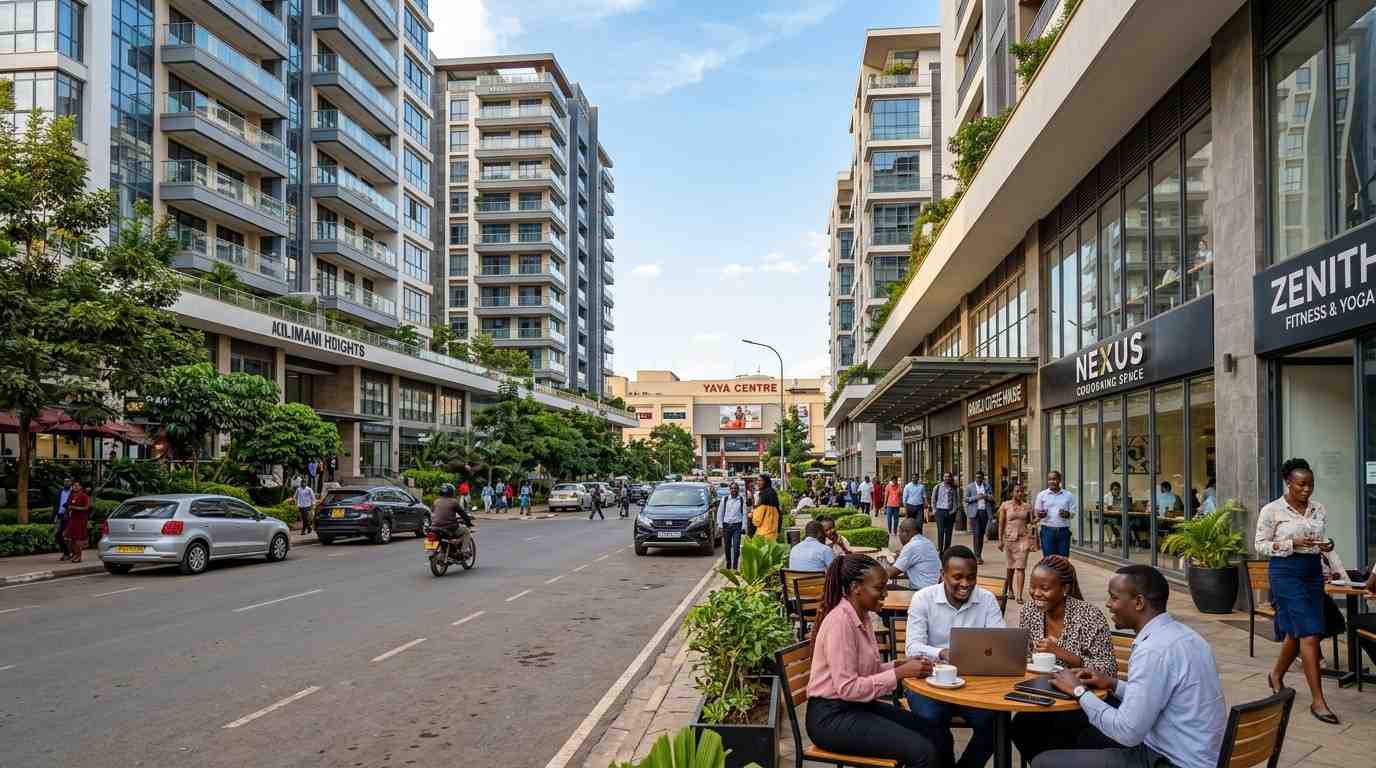
Kilimani
"The young professional's default — and for very good reason."
Kilimani is Nairobi's young professional heartbeat. Sitting just south of Westlands and a quick drive from Upper Hill and the CBD, it blends a dense residential feel with commercial energy — modern apartment blocks, buzzing cafés, NGO offices, tech hubs, and boutique gyms all within walking distance of each other. Yaya Centre and Junction Mall serve as the neighbourhood's social anchors, offering everything from grocery runs to rooftop sundowners.
The area has become a magnet for NGO workers, fintech employees, media professionals, and startup founders. Co-working spaces like Ikigai Nairobi and Workstyle Africa have set up in Kilimani, making it a natural fit for remote workers and freelancers who want a professional environment without commuting to the CBD every day.
Rent for a modern one-bedroom starts around KSh 40,000/month, climbing to KSh 95,000+ for serviced apartments with swimming pools, backup power, and concierge services. Two and three-bedroom units — popular among housemates splitting costs — typically land between KSh 70,000 and KSh 160,000, reflecting Kilimani's continued premium pricing driven by high demand and high-rise construction activity.
✓ Pros
- 15–20 min drive to CBD & Upper Hill
- Highest density of co-working spaces
- Vibrant café, restaurant & fitness culture
- Strong expat & NGO community network
- Excellent Nairobi Expressway access
✗ Cons
- One of the pricier rental markets
- Traffic on Ngong Road at peak hours
- Parking can be a nightmare in older blocks
- Ongoing construction noise in some zones

Westlands
"Nairobi's living room — if you never sleep."
Westlands is where multinational corporations, international banks, and tech companies planted their Nairobi flags — and where the nightlife scene followed. If you work for a corporate employer with Nairobi offices or frequently need to network with business professionals, living in Westlands puts you at the centre of the action. The Alchemist Bar, Kiza Lounge, and Havana Bar are not just places to unwind — they are industry networking events wearing casual clothes.
On the dining front, Westlands is unrivalled. From modern Asian cuisine to Mexican flavours to Ethiopian injera, the area's culinary diversity mirrors its international professional community. Sarit Centre, The Mall, and a growing strip of independent restaurants make grocery runs and dinner plans equally easy.
The trade-off is cost. A modern one-bedroom apartment in Westlands rarely falls below KSh 60,000/month, and quality serviced units frequently exceed KSh 120,000–150,000. The neighbourhood rewards those whose careers genuinely benefit from proximity to its corporate and entertainment ecosystem — for everyone else, it may be an expensive luxury.
✓ Pros
- Nairobi's top nightlife & dining hub
- Massive concentration of corporate offices
- Excellent short-term Airbnb market (invest potential)
- Proximity to UN offices & diplomatic missions
- Strong international community
✗ Cons
- Among the most expensive neighbourhoods
- Noise from bars & nightlife venues
- Weekend congestion is severe
- Limited green space / parks nearby
Kileleshwa
"Premium calm without paying Lavington prices."
Kileleshwa sits in the sweet spot between Westlands' buzz and Lavington's quiet luxury — and for professionals who want high-quality housing without the premium of either, it is the shrewdest address in Nairobi. The neighbourhood is characterised by tree-lined streets, low-density development, and modern luxury apartment blocks that are drawing strong demand from young professionals who commute to Westlands, Upper Hill, or the CBD.
Compared to its neighbours, Kileleshwa punches above its weight on safety and quality of life. Its residential character means less traffic and noise at night, while its central location keeps you within 15–25 minutes of most major business districts. Property appreciation here has been consistently strong, making it an attractive option for professionals considering purchasing rather than renting.
Rent for a well-appointed one-bedroom starts around KSh 45,000/month, with newer high-rise units offering gym access, rooftop terraces, and back-up generators commanding KSh 80,000–110,000. The gap between what you get and what you pay puts Kileleshwa ahead of Westlands for price-conscious professionals who still want quality.
✓ Pros
- Quieter & more residential than Westlands
- Strong property appreciation track record
- High safety ratings vs comparable areas
- Good access to Kilimani's social scene
- Newer apartment stock with modern amenities
✗ Cons
- Fewer walkable dining & entertainment options
- Can feel isolated for newcomers to Nairobi
- Public transport options limited
- Some roads flood during heavy rains
Ruaka
"Where your KSh 40,000 budget gets you a genuinely good apartment."
Ruaka has undergone a remarkable transformation over the past five years, evolving from a quiet satellite town into one of Nairobi's most sought-after suburbs for young professionals priced out of Kilimani and Westlands. Located along Limuru Road and linked to the Northern Bypass, the area's construction boom has delivered a steady supply of modern, well-finished apartments at a fraction of inner-city prices.
The anchor of Ruaka's appeal is proximity to Two Rivers Mall — one of the largest shopping centres in East Africa — which provides dining, cinema, supermarkets, and entertainment without needing to venture into the congested city centre. Land values in Ruaka have actually surpassed those in Karen and Runda, a testament to the extraordinary demand the area has attracted. For professionals working in Gigiri, Runda, or along the Northern Bypass, Ruaka is the most logical base.
A modern one-bedroom apartment here rents for KSh 30,000–45,000/month, and two-bedrooms with amenities are routinely available for KSh 50,000–60,000 — values that are difficult to find anywhere in Nairobi's established suburbs. The main limitation is commute time into the CBD: budget 45–60 minutes during peak hours via Limuru Road.
📍 Insider Note
Ruaka residents who need to work from an office regularly should consider equipping a solid home workstation. Check out our roundup of the best laptops for online jobs in Kenya to future-proof your remote setup.
✓ Pros
- Best rent-to-quality ratio in this guide
- Modern apartment stock, good amenities
- Two Rivers Mall minutes away
- Northern Bypass access (Westlands in 20 min)
- Growing restaurant & café scene
✗ Cons
- 45–60 min to CBD during peak hours
- Limuru Road can be slow in the morning
- Co-working supply still limited vs Kilimani
- Less established professional social network
Ngong Road Corridor & Rongai
"Stretch your shilling further without sacrificing city access."
The Ngong Road corridor — encompassing areas such as Rongai, Langata, and Dagoretti — represents Nairobi's most accessible entry point for young professionals entering the job market or early in their careers. One-bedroom apartments here can be found from as low as KSh 20,000–25,000/month, freeing up significant income for savings, investments, or student loan repayment.
Rongai in particular has a large and growing population of young professionals who commute into the city, drawn by affordable townhouses, matatu convenience, and a surprisingly active local dining and social scene that has matured in step with the suburb's rapid growth. The trade-off, as with Ruaka, is commute time — Rongai to CBD can take 60–90 minutes during peak traffic, making it best suited for professionals whose offices are in the south of the city, or who work remotely.
For those considering homeownership — even as a junior professional — the Ngong Road corridor and Rongai offer accessible land and apartment prices not available inside the city. Paired with Nairobi's improving road infrastructure, this area's long-term value proposition is compelling.
✓ Pros
- Most affordable rents in this guide
- Spacious apartments & townhouses available
- Good access to Ngong Hills & green spaces
- Growing retail & food scene
- Strong long-term appreciation potential
✗ Cons
- Long commute to CBD (>60 min peak hours)
- Fewer professional networking opportunities locally
- Co-working spaces scarce
- Social infrastructure still developing
Side-by-Side Comparison: Nairobi's Top Neighbourhoods
Use this table to quickly assess which neighbourhood aligns with your priorities, salary bracket, and working style.
| Neighbourhood | 1-Bed Rent (KSh/mo) | CBD Commute | Nightlife | Co-working | Best For |
|---|---|---|---|---|---|
| Kilimani ⭐ | 40,000 – 95,000 | 15–20 min | ★★★★☆ | ★★★★★ | Best overall balance |
| Westlands | 60,000 – 150,000 | 10–15 min | ★★★★★ | ★★★★☆ | Corporate & nightlife |
| Kileleshwa | 45,000 – 110,000 | 20–25 min | ★★★☆☆ | ★★★☆☆ | Quiet, quality living |
| Ruaka | 30,000 – 60,000 | 35–55 min | ★★★☆☆ | ★★☆☆☆ | Value & modern stock |
| Ngong Road / Rongai | 20,000 – 45,000 | 50–90 min | ★★☆☆☆ | ★★☆☆☆ | Budget & space |
⭐ Editor's Pick. Rent figures are mid-2025 market estimates; actual prices vary by building age, floor level, and included utilities. Always verify with the landlord or agent before committing.
How to Choose the Right Nairobi Neighbourhood for Your Career Stage
Early Career (Salary: KSh 40,000 – 80,000/month)
Prioritise Ruaka or the Ngong Road corridor. Keeping rent below 30% of your gross income is a sound financial rule — at this salary bracket, that means a budget of KSh 12,000–24,000/month on accommodation. Sharing a two-bedroom in Ruaka or Rongai with a housemate is a financially smart move that lets you save aggressively in your early years. If your employer is based in Westlands or along the Northern Bypass, Ruaka's commute becomes a genuine non-issue.
For budget laptop and tech gear to set up your home office affordably, see our guide on the best value-for-money laptops in Kenya.
Mid Career (Salary: KSh 80,000 – 200,000/month)
Kilimani and Kileleshwa are the natural sweet spots at this stage. You have enough income to afford a quality one-bedroom solo, access to the professional and social networks that accelerate career growth, and proximity to the offices and co-working spaces where opportunities emerge. Aim to spend no more than KSh 50,000–80,000/month on rent, leaving meaningful room for savings, investments, and lifestyle spending.
Senior Professional / Expatriate (Salary: KSh 200,000+/month)
Westlands, Lavington, or Kileleshwa serviced apartments are your natural territory. At this level, the time saved by a shorter commute has measurable financial value, and access to quality networking environments is genuinely career-accelerating. Westlands specifically makes sense if your role involves regular client entertainment or frequent international travel via Wilson Airport.
📋 Checklist Before Signing a Lease
Verify these before committing: (1) Backup power generator and how costs are shared. (2) Borehole or reliable water supply. (3) Security — CCTV, guards, controlled access. (4) Internet infrastructure — fibre availability is non-negotiable for remote professionals. (5) Parking allocation if you own a vehicle. See our Mercedes-Benz Kenya guide if you're also considering upgrading your vehicle to match the neighbourhood.
Frequently Asked Questions
What are the best neighborhoods in Nairobi for young professionals?
The top picks are Kilimani (best overall), Westlands (best social life and corporate access), Kileleshwa (best for serene quality living), Ruaka (best value for money), and Ngong Road/Rongai (most affordable). Your ideal choice depends on your salary, employer location, and lifestyle priorities.
How much does it cost to rent in Nairobi in 2025?
Rent varies significantly. Budget areas like Rongai and Ruaka offer one-bedroom apartments from KSh 20,000–45,000/month. Mid-range areas like Kilimani and Kileleshwa range from KSh 40,000–110,000 for a one-bedroom. Premium zones like Westlands start from KSh 60,000 and can exceed KSh 150,000/month for serviced units.
Is Kilimani safe for young professionals?
Yes, Kilimani is considered one of the safer residential areas in Nairobi. Most apartment blocks have controlled access, CCTV, and 24-hour security guards. As with any urban area, standard personal security awareness is advisable, particularly at night. The neighbourhood's dense, well-lit commercial strips also help maintain safety levels.
Which Nairobi neighborhood has the best nightlife?
Westlands is Nairobi's undisputed nightlife capital, home to The Alchemist Bar, Kiza Lounge, Havana Bar, and dozens of restaurants and clubs. Kilimani is a close second, with a growing dining and cocktail bar scene that caters to the professional-creative crowd.
Is Ruaka a good place to live in Nairobi?
Absolutely — especially for young professionals on a budget. Ruaka's construction boom has delivered modern, well-equipped apartments at prices well below inner-city neighbourhoods. Its proximity to Two Rivers Mall and the Northern Bypass make it a convenient and growing suburb. The main trade-off is a longer commute into the CBD.
What documents do I need to rent a house in Nairobi?
Standard requirements include a copy of your national ID or passport, recent payslips or bank statements (3 months), and a reference letter from your employer or previous landlord. Some landlords also require a guarantor or up to 3 months' rent as a security deposit.
Our Final Verdict
For most young professionals relocating to or within Nairobi, Kilimani remains the benchmark choice — it delivers the best all-round package of career proximity, social infrastructure, and lifestyle quality. If your budget is tight and you're willing to accept a longer commute, Ruaka offers the most impressive value for money in 2025. And if your career is in corporate finance, tech, or international business, the premium for Westlands often pays for itself in networking ROI.
Ultimately, the best neighbourhood in Nairobi is the one that keeps your commute under 30 minutes, your rent under 30% of take-home pay, and your social and professional options open. Use the comparison table in this guide, visit each neighbourhood at different times of day, and — critically — view the apartment before you pay a single shilling in deposit.