Personal finance basics are the small, simple money habits that decide whether you build real wealth in Kenya or keep struggling paycheck to paycheck. Many Kenyans want to invest in shares, land, or a business, but they skip the first steps — saving, budgeting, and clearing debt — and end up selling investments too early or borrowing at high interest to survive. This guide walks you through every basic step, in plain and simple language, so you can invest with a strong and steady foundation.

What You Will Learn
- Should You Save Before You Invest?
- How to Create an Emergency Fund
- How Much Should You Save Before Buying Shares?
- Paying Off Debt vs Investing
- Creating an Investment Budget
- The 50/30/20 Budget Rule
- How Lifestyle Inflation Hurts Investors
- Financial Habits of Successful Investors
- How to Increase Your Investment Capital
- Investing on an Irregular Income
- Should You Borrow to Invest?
- Building Wealth on an Average Kenyan Salary
- Frequently Asked Questions
Should You Save Before You Invest?
Yes, always save first. Saving builds a cushion so that when life throws a surprise at you — a hospital bill, a job loss, a broken phone — you do not have to sell your shares at a bad time just to survive. Investors who skip saving often panic-sell during a dip in the Nairobi Securities Exchange because they need cash right away. A small saved cushion means your investments get time to grow properly.
Think of saving as the foundation of a house. You would not build the walls before the foundation is dry. Money works the same way.
How to Create an Emergency Fund
An emergency fund is money set aside only for real emergencies, not shopping or holidays. Here is a simple way to build one in Kenya:
- Start small. Even Ksh 500 a week adds up to Ksh 26,000 in a year.
- Use a separate account. Keep it in a money market fund or a separate M-Pesa Lock Savings account so you are not tempted to spend it.
- Automate it. Set a standing order right after payday, before you spend on anything else.
- Grow it slowly. Aim for 3 months of expenses first, then push toward 6 months.
How Much Should You Save Before Buying Shares?
Before you open a CDS account and start buying shares, most advisors recommend having your emergency fund fully in place. That means 3 to 6 months of your normal monthly expenses saved and untouched. Once that fund is ready, you can start investing with as little as Ksh 5,000 in shares or a unit trust, and grow it from there.
Do not wait until you have a huge amount before you start. The habit of investing small and often matters more than the size of your first investment.
Paying Off Debt vs Investing
This is one of the biggest questions Kenyan investors ask. The rule of thumb is simple: if your debt's interest rate is higher than what you can realistically earn from investing, pay off the debt first.
| Debt Type | Typical Interest | Pay First? |
|---|---|---|
| Mobile loan apps (Fuliza, KCB M-Pesa) | Very high, often above 50% annualized | Yes, urgently |
| Credit card debt | High, around 30–40% annually | Yes |
| SACCO loans | Moderate, often 12–14% | Compare with expected returns |
| Mortgage or asset-backed loan | Lower, often single digits to low teens | Can invest alongside |
High interest debt grows faster than most investments can, so clearing it first is almost always the smarter move.
Creating an Investment Budget
An investment budget is simply deciding, in advance, how much money moves from your salary into investments every single month. Without this plan, investing becomes something you only do "if there is money left" — and there is rarely money left.
- List your total monthly income.
- Subtract your essential needs (rent, food, transport).
- Subtract your debt repayments.
- Set a fixed percentage of what remains for investing, even if it is small.
- Automate the transfer so it happens before you can spend it.
The 50/30/20 Budget Rule
The 50/30/20 rule is one of the easiest budgeting tools for Kenyan salaries. It splits your after-tax income into three simple buckets:
50% Needs: rent, food, transport, school fees.
30% Wants: entertainment, eating out, shopping.
20% Save or Invest: emergency fund, shares, SACCO, unit trusts.
If your income is irregular, you can adjust the percentages, but always try to protect that final slice for saving and investing.
How Lifestyle Inflation Hurts Investors
Lifestyle inflation happens when your spending rises every time your income rises. You get a raise, and suddenly you upgrade your phone, move to a pricier estate, and eat out more — leaving the same small amount, or nothing, for investing.
The fix is simple: whenever your income increases, increase your investment percentage first, then let your lifestyle catch up slowly.
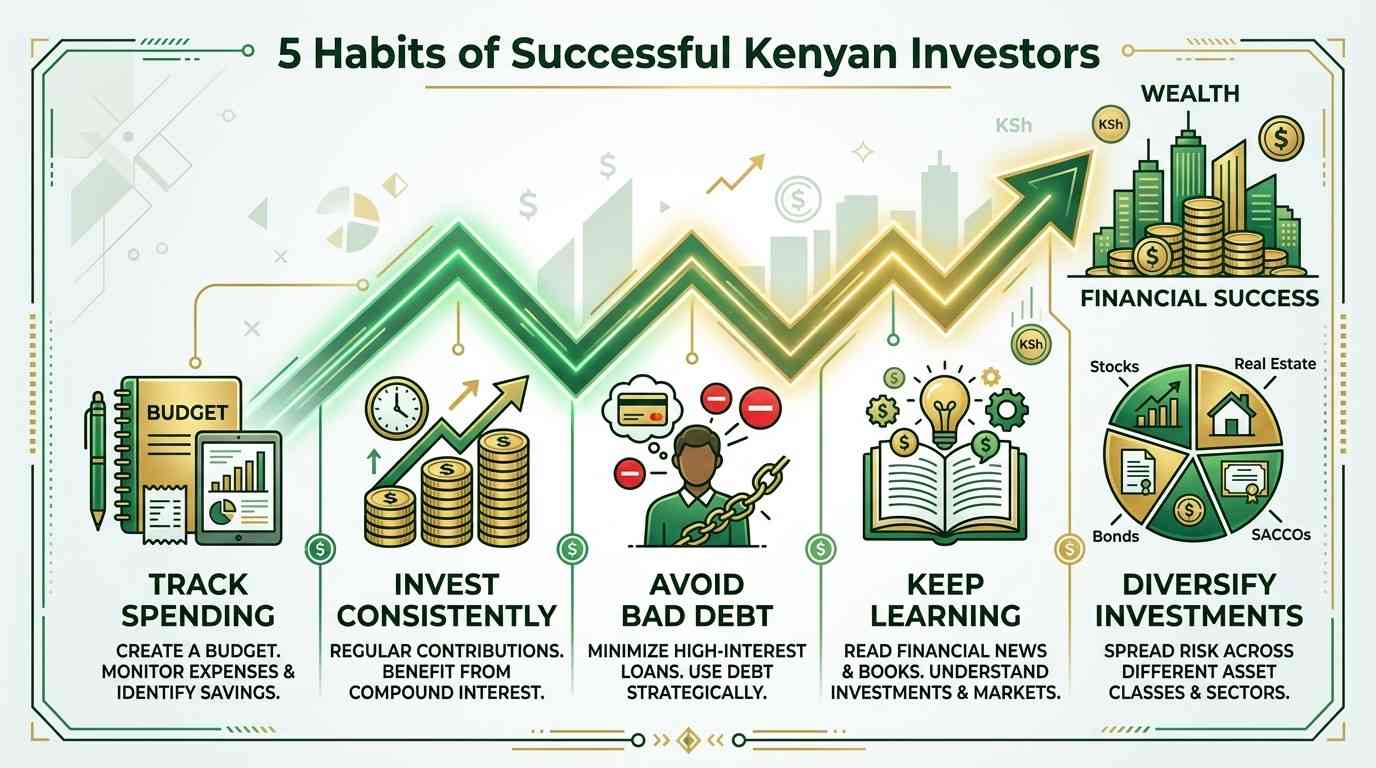
Financial Habits of Successful Investors
- They track their spending. They know exactly where every shilling goes.
- They invest consistently. Small, regular amounts beat waiting for a "big" amount.
- They avoid impulse debt. They think twice before taking mobile loans for wants.
- They keep learning. They read guides like this one and follow common investing questions to avoid costly mistakes.
- They diversify. They spread money across shares, SACCOs, and other investment options rather than putting everything in one place.
How to Increase Your Investment Capital
Investment capital is simply the money you have available to invest. Here are practical ways Kenyans grow theirs:
- Side hustles: freelancing, selling goods, or content creation can add extra capital every month.
- Cutting unnecessary subscriptions: redirect that money into shares or a unit trust instead.
- Reinvesting dividends: instead of spending dividend payouts, use them to buy more shares.
- Selling unused assets: old electronics or furniture can become fresh investment capital.
- Choosing better sectors: understanding which sectors perform best helps your existing capital grow faster.
Investing on an Irregular Income
Many Kenyans, especially freelancers, boda riders, and small traders, do not earn the same amount every month. This does not mean you cannot invest. Instead of a fixed monthly amount, invest a fixed percentage of every payment you receive.
For example, if you decide on 10%, then a Ksh 3,000 payment means Ksh 300 invested, and a Ksh 30,000 payment means Ksh 3,000 invested. This keeps your habit consistent even when your income is not.
Should You Borrow to Invest?
For most beginner and average Kenyan investors, the answer is no. Borrowed money comes with interest that must be repaid whether your investment goes up or down. If the market falls right after you borrow, you are left repaying a loan on money you have already lost.
Experienced investors sometimes use carefully structured borrowing for specific opportunities, but this requires deep market knowledge and risk tolerance most beginners do not yet have. It is safer to invest only what you already own.
Building Wealth on an Average Kenyan Salary
You do not need a huge salary to build wealth in Kenya. What matters more is consistency. Someone earning Ksh 40,000 a month who invests 15% every month, without fail, for 15 years will often end up wealthier than someone earning Ksh 150,000 who invests nothing.
- Automate a fixed investment amount every payday.
- Keep your lifestyle modest as your income grows.
- Use tools like the NSE Dividend Calculator to track how your shares are performing.
- Review your budget every few months using free personal finance calculators.
Ready to Start Buying Shares?
If you are interested in buying shares on the Nairobi Securities Exchange, we recommend working with a licensed and trusted stockbroker to get started the right way.
Get Started with Faida Investment BankFrequently Asked Questions
Should you save before you invest?
Yes. Build a small emergency fund first, then start investing. Saving first protects you from selling shares at a loss when unexpected costs come up.
How much should I save before buying shares in Kenya?
Most advisors suggest 3 to 6 months of your expenses in an emergency fund before you put money into shares. You can start investing with as little as Ksh 5,000 once that fund is in place.
Should I pay off debt or invest first?
Pay off high interest debt like mobile loans first. Their interest rates are usually higher than typical investment returns, so clearing them first saves you more money overall.
Can I invest on an irregular income?
Yes. Invest a fixed percentage of every payment you receive, rather than a fixed monthly amount. This keeps you consistent even when your income changes.
Should you borrow money to invest?
It is risky and not recommended for beginners. Borrowed money has interest and must be repaid whether your investment grows or falls.
Mastering these personal finance basics is what separates Kenyans who slowly build wealth from those who stay stuck. Start with saving, clear your high interest debt, budget with intention, and only then grow your investment capital steadily. For more official guidance on managing money and understanding regulated financial products in Kenya, you can also visit the Central Bank of Kenya and the Capital Markets Authority.