Wealth through the NSE in Kenya starts with one simple idea: small amounts of money, invested often and left alone for a long time, grow into big amounts of money. The Nairobi Securities Exchange, or NSE, is the marketplace where Kenyans buy small pieces of big companies like Safaricom, Equity Bank, and KCB. Every time you buy a share, you become a part-owner of that company. This guide will show you, in very simple words, how to use the NSE to build real wealth, step by step, even if you are starting with almost nothing.
You build wealth through the NSE in Kenya by buying shares of strong companies regularly, reinvesting dividends, and holding for many years. A person who invests just Ksh 10,000 every month and earns a 12% average yearly return can pass Ksh 10 million in about 20 years, mostly through the power of compounding.
What You Will Learn
- Why the NSE Matters for Ordinary Kenyans
- How to Become Financially Independent Through Investing
- How Young Kenyans Can Build Wealth Early
- Investing for Retirement in Kenya
- How Compounding Builds Wealth
- Why Time Matters More Than Timing the Market
- How to Grow Ksh 10,000 Through Investing
- Investing Monthly in NSE Shares
- Building Passive Income Through Shares
- Long-Term Wealth Creation Strategies
- Millionaire Lessons From Investing
- How to Get Started on the NSE
- Frequently Asked Questions
Why the NSE Matters for Ordinary Kenyans
The NSE is not just for rich businesspeople in suits. It is open to any Kenyan adult with a valid ID and a little bit of money. When you buy shares, your money goes to work inside real companies that sell airtime, lend money, brew beer, or make cement. As these companies grow and make profit, the value of your shares grows too. Some companies also share their profit with you every year through dividends.
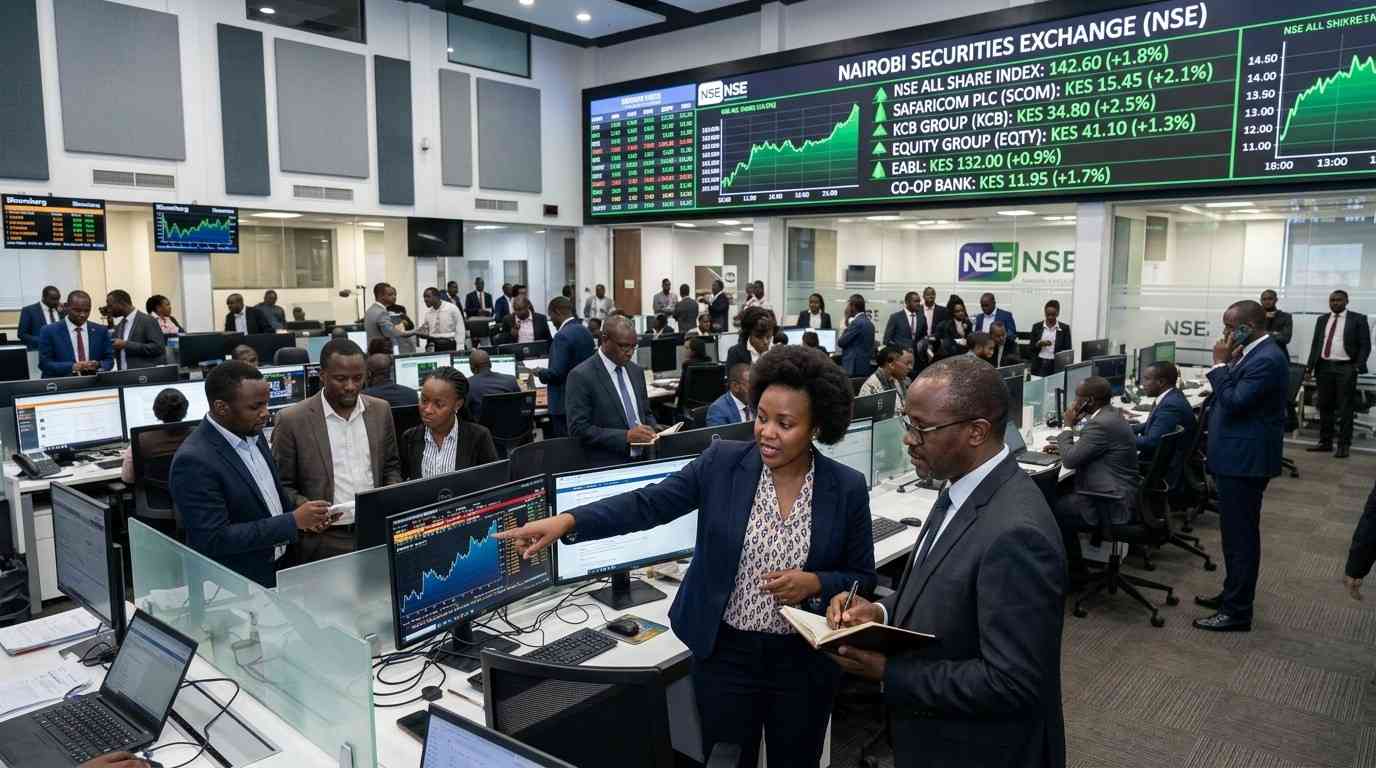
Compare this to keeping money under a mattress or in a normal savings account. Inflation quietly eats that money every year. Shares, on the other hand, have historically grown faster than inflation over long periods, which is why serious investors treat the NSE as one of the strongest long-term wealth tools in Kenya. If you are still unsure whether shares are worth the risk, this breakdown of the biggest risks of investing in the NSE in Kenya will help you invest with your eyes open.
Before you open an account, it also helps to know your rights as a shareholder — see our guide to regulations for NSE investors in Kenya.
How to Become Financially Independent Through Investing
Financial independence simply means your money can pay your bills without you working every single day for it. Most Kenyans depend fully on a salary. If the salary stops, life stops. Investing changes this by building a second source of money that keeps growing whether you are at work, asleep, or on leave.
To become financially independent through investing, you need three things working together: a habit of saving part of every income, a place to put that saving where it can grow, and enough years for growth to happen. The NSE gives you the second part. Your own discipline gives you the first and third.
If you're still building your saving habit, our guide on personal finance basics every Kenyan investor should know covers the foundation this section assumes you already have.
How Young Kenyans Can Build Wealth Early
Young Kenyans have one huge advantage over older investors: time. A 24-year-old who starts investing today will always beat a 40-year-old who starts with the same amount of money, simply because the younger person's money has more years to grow.
Here is how young Kenyans, including students and first-time job holders, can start building wealth early:
- Open a CDS account with a licensed stockbroker while still in your twenties, even with a small amount.
- Buy shares in strong, well-known companies instead of chasing "hot tips" from friends.
- Automate a small monthly deposit into your investment account, the same way you pay for airtime.
- Avoid withdrawing your investment for small emergencies. Build a separate small emergency fund first.
- Keep learning. Read one guide, like this guide on how to analyze stocks before buying in Kenya, every month.
When you're ready to place your first order, our step-by-step guide to buying shares in Kenya walks through the process, and our 10 best shares to buy in Kenya is a good shortlist to start researching from.
A 22-year-old who invests Ksh 5,000 every month can end up with more money at retirement than a 40-year-old who invests Ksh 15,000 every month, simply because of time. — The mathematics of compounding
Investing for Retirement in Kenya
Most Kenyans depend on NSSF alone for retirement, and NSSF payouts are often too small to maintain a comfortable life. Investing for retirement in Kenya through the NSE gives you a second, bigger retirement fund that you control completely.
The trick is to treat your NSE portfolio like a private pension. Choose companies with a long history of paying dividends, such as banks and telecom firms, and reinvest every dividend instead of spending it. Over 25 to 30 years, this reinvestment turns into a large retirement fund that can pay you a monthly "salary" from dividends alone, long after you stop working.
| Years Invested | Total Money Put In | Estimated Value at 12% Return |
|---|---|---|
| 10 years | Ksh 960,000 | Ksh 1,850,000 |
| 20 years | Ksh 1,920,000 | Ksh 7,900,000 |
| 30 years | Ksh 2,880,000 | Ksh 26,300,000 |
These figures are simple estimates for teaching purposes. Real NSE returns move up and down every year and are never guaranteed.
To structure this properly rather than buying shares at random, see our guide on how to build an investment portfolio in Kenya, and once your portfolio matures, our advanced investing strategies for experienced Kenyan investors covers the next stage.
How Compounding Builds Wealth
Compounding is what happens when the profit you earn also starts earning its own profit. Albert Einstein reportedly called compound interest one of the most powerful forces in finance, and once you see the numbers, it is easy to understand why.
Imagine you invest Ksh 100,000 and it grows by 12% in one year. You now have Ksh 112,000. In year two, the 12% growth is calculated on Ksh 112,000, not the original Ksh 100,000. Every year, your base amount gets bigger, so the same growth rate produces a bigger and bigger amount of money in shillings.
| Year | Value at Start | Growth (12%) | Value at End |
|---|---|---|---|
| 1 | Ksh 100,000 | Ksh 12,000 | Ksh 112,000 |
| 5 | Ksh 157,352 | Ksh 18,882 | Ksh 176,234 |
| 10 | Ksh 277,308 | Ksh 33,277 | Ksh 310,585 |
| 20 | Ksh 863,271 | Ksh 103,593 | Ksh 966,864 |
Why Time Matters More Than Timing the Market
Many beginners waste months trying to guess the "perfect" day to buy shares, hoping to catch the lowest price. This is called timing the market, and even professional fund managers struggle to do it well. What actually builds wealth is time in the market, not perfect timing.
Someone who invests steadily every month for 20 years, through both good and bad NSE seasons, almost always ends up richer than someone who keeps waiting for the "right moment" and only invests occasionally. Waiting for perfect timing usually just means losing valuable years of growth.
If you're tempted to trade in and out based on price movements, our guide on how to spot overvalued vs undervalued stocks in Kenya explains why that's harder than it looks, even for professionals.
How to Grow Ksh 10,000 Through Investing
Ksh 10,000 feels small, but it is a real starting point on the NSE. Here is a simple, realistic path for growing it:
- Open a CDS account through a licensed stockbroker such as Faida Investment Bank.
- Use the Ksh 10,000 to buy shares in two or three financially strong companies instead of just one, to spread your risk.
- Leave the money untouched for at least five years. Selling too early kills compounding before it even starts.
- Add more money whenever you can, even Ksh 500 at a time, to speed up growth.
- Reinvest any dividends you receive instead of withdrawing them.
For a broader look at what's realistic at different starting amounts, see how to invest at every income level in Kenya, from Ksh 500 to Ksh 1 million.
At a steady 12% average yearly return, Ksh 10,000 left alone for 20 years, with no extra deposits, grows to roughly Ksh 96,000. Add even a small monthly top-up, and the number climbs much faster, as shown in the retirement table above.
Investing Monthly in NSE Shares
Investing monthly in NSE shares, sometimes called cost averaging, means buying a fixed amount of shares every month regardless of whether prices are high or low that month. This removes the stress of guessing prices and builds a strong savings habit, because it matches how most Kenyans already get paid, monthly.
Over time, monthly investing means you naturally buy more shares when prices are low and fewer shares when prices are high, which smooths out your average buying price. For more tactics beyond simple cost averaging, our 12 proven investment strategies that work in Kenya covers a wider toolkit. If you want to compare which sectors are best suited for this steady approach, see this ranking of the best sectors to invest in Kenya.
Building Passive Income Through Shares
Passive income is money that keeps arriving even when you are not actively working. On the NSE, this passive income mostly comes from dividends, which are cash payments some companies share with their shareholders, usually once or twice a year.
To build strong passive income through shares, focus on companies with a long, reliable history of paying dividends, rather than companies that only promise fast price growth. A well-built dividend portfolio can eventually pay you a yearly "bonus" that feels like a second salary, without you selling a single share. You can check real payout numbers using free tools like this NSE dividend calculator before choosing which companies to invest in.
Ready to Buy Your First NSE Shares?
Faida Investment Bank is a licensed stockbroker that helps everyday Kenyans open a CDS account, buy shares, and start their investing journey the right way.
Start Investing With Faida Investment BankLong-Term Wealth Creation Strategies
Long-term wealth creation on the NSE is less about finding a "secret stock" and more about following a few boring but powerful strategies for many years:
- Diversify. Spread your money across different sectors like banking, telecom, and manufacturing, instead of one single company.
- Reinvest dividends. Use every dividend payment to buy more shares instead of spending it.
- Ignore short-term noise. Daily price movements rarely matter if your goal is 10 to 30 years away.
- Increase your contributions. As your salary grows, increase your monthly investment amount too.
- Review yearly, not daily. Checking your portfolio every day can lead to panic decisions. Review it once or twice a year instead.
Your NSE holdings also don't have to be your only asset class — our feature on investing in Laikipia County: farming, tourism, and real estate shows how shares and real estate can work together in one plan. For a wider view of where else Kenyans put their money, this guide on the best investment options in Kenya is a useful companion to this article.
Millionaire Lessons From Investing
People who have built real wealth through shares, in Kenya and around the world, tend to share the same few habits. Here are the biggest millionaire lessons from investing:
- They started early, even with small amounts, instead of waiting to "have enough" money first.
- They avoided panic-selling during market downturns, treating dips as normal weather, not disasters.
- They kept their investing costs low by avoiding unnecessary trading and high fees.
- They learned continuously, and never invested in a company they did not understand.
- They separated facts from rumors, especially the false beliefs covered in these investing myths that cost Kenyans money. Understanding a company before you invest in it, rather than chasing hype, is a habit our Safaricom stock analysis guide demonstrates step by step.
The biggest millionaire secret on the NSE is not a secret at all. It is simply starting early, staying invested, and refusing to panic. — A lesson repeated by almost every long-term investor
How to Get Started on the NSE
- Choose a licensed stockbroker, such as Faida Investment Bank, that is regulated by the Capital Markets Authority.
- Open a CDS (Central Depository System) account using your national ID and a passport photo.
- Fund your trading account through mobile money or bank transfer.
- Pick two or three companies to start with, ideally from different sectors.
- Place your first buy order, then commit to adding money every month.
Need more detail on any of these steps? Our step-by-step guide to buying shares in Kenya and 10 best shares to buy in Kenya pick up exactly where this list leaves off.
Need a Reliable Laptop to Track Your Investments?
A good laptop makes it easier to research companies, track NSE prices, and manage your CDS account online.
WhatsApp 0714 701 814 for Laptop Deals
Frequently Asked Questions
How much money do I need to start building wealth through the NSE in Kenya?
You can start with as little as enough funds to buy 1 share, though Ksh 10,000 gives you enough room to buy a small basket of shares and pay brokerage fees comfortably.
Can I really become a millionaire from NSE shares?
Yes, but it takes time. Someone who invests Ksh 10,000 every month for 20 years at a 12% average annual return can cross Ksh 10 million, mostly from compounding, not luck.
Is the NSE safe for beginners?
No investment is 100% safe, but the NSE is regulated by the Capital Markets Authority. Spreading your money across several strong companies lowers your risk. For the specific rules and protections in place for shareholders, see our guide to regulations for NSE investors in Kenya.
How do I buy shares on the NSE?
You open a CDS account through a licensed stockbroker, fund it, then place buy orders for the shares you want. A broker like Faida Investment Bank can guide you through this.
Is it better to invest monthly or invest a lump sum once?
Investing monthly, known as cost averaging, is easier for most Kenyans because it matches salary cycles and reduces the risk of buying everything at a high price.
Final Word
Wealth through the NSE in Kenya is not built overnight, and it is not built by luck. It is built by ordinary Kenyans who choose to start early, invest a little every month, ignore short-term noise, and let compounding quietly do the heavy lifting over many years. The best time to start was years ago. The next best time is today.