Farming in Kenya is highly profitable when you choose the right venture. Top opportunities include dairy farming (KSh 30,000–120,000/month), poultry farming (KSh 20,000–80,000/cycle), avocado farming (KSh 200,000+/acre/season), greenhouse horticulture, fish farming, and high-value crops like garlic, dragon fruit, and coffee.
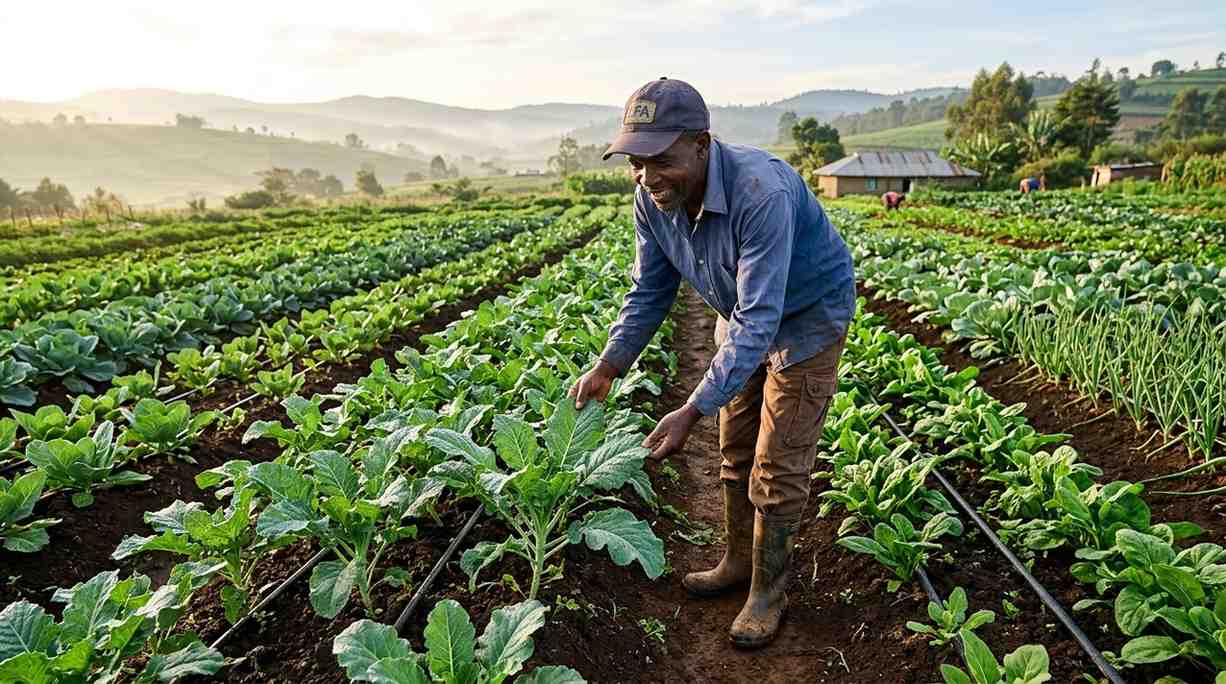
Kenya agriculture: smallholder farmers account for over 70% of the country's food production.
: Why Farming in Kenya Is a Big Deal
Farming in Kenya contributes approximately 33% of the country's GDP and employs more than 40% of the total workforce, according to the Food and Agriculture Organisation (FAO). Yet the vast majority of Kenyan farmers are still smallholders — meaning there is enormous room to modernise, scale, and profit.
Whether you are a first-time farmer with just KSh 30,000 to start, or an investor with KSh 2 million looking to build a serious agribusiness, Kenya's climate diversity, growing middle-class appetite, and expanding export markets make this one of the best times in history to get into farming.
In this guide, we break down the top 20 farming opportunities in Kenya for 2025, covering start-up costs, likely returns, best counties to operate in, and practical tips to help you succeed. We also link to useful resources, government agencies, and tech platforms that can give you an edge.
Read on — and by the end, you will know exactly which farming venture makes the most sense for your budget and location.
Top Farming Opportunities in Kenya at a Glance
| # | Farming Type | Min Start-Up (KSh) | Monthly/Cycle Earnings | Best Regions | Difficulty |
|---|---|---|---|---|---|
| 1 | Dairy Farming | 120,000 | KSh 30,000–120,000 | Rift Valley, Central | Medium |
| 2 | Poultry (Kienyeji/Broiler) | 20,000 | KSh 20,000–80,000 | Nationwide | Low |
| 3 | Avocado Farming | 60,000 | KSh 50,000–250,000/season | Murang'a, Meru, Kisii | Low |
| 4 | Greenhouse Horticulture | 150,000 | KSh 80,000–400,000/cycle | Rift Valley, Central | Medium |
| 5 | Fish Farming | 80,000 | KSh 30,000–120,000/cycle | Nyanza, Rift Valley | Medium |
| 6 | Coffee Farming | 80,000/acre | KSh 60,000–300,000/harvest | Central, Mt. Kenya | Medium |
| 7 | Mushroom Farming | 15,000 | KSh 20,000–60,000/month | Nationwide (indoor) | Medium |
| 8 | Garlic Farming | 40,000/acre | KSh 300,000–600,000/acre | Central, Rift Valley | Medium |
| 9 | Dragon Fruit Farming | 100,000 | KSh 150,000–500,000/acre | Coastal, Machakos | Medium |
| 10 | Goat Farming | 30,000 | KSh 15,000–60,000/month | Nationwide | Low |
| 11 | Maize Farming | 15,000/acre | KSh 30,000–80,000/acre | Rift Valley, Western | Low |
| 12 | Irish Potato Farming | 40,000/acre | KSh 80,000–250,000/acre | Nyandarua, Meru, Kericho | Medium |
| 13 | Tomato Farming | 30,000/quarter-acre | KSh 60,000–200,000/cycle | Rift Valley, Kirinyaga | Medium |
| 14 | Bee Farming (Apiculture) | 10,000 | KSh 20,000–80,000/season | Coast, Rift Valley, Eastern | Low |
| 15 | Hydroponic Farming | 80,000 | KSh 40,000–200,000/month | Nairobi, Mombasa, Kisumu | High |
| 16 | Banana Farming | 30,000/acre | KSh 40,000–150,000/harvest | Meru, Kisii, Coast | Low |
| 17 | Onion Farming (Bulb) | 25,000/quarter-acre | KSh 60,000–200,000/acre | Rift Valley, Eastern | Medium |
| 18 | Organic Farming | 30,000 | Premium over conventional (30–80%) | Nationwide | Medium |
| 19 | Sunflower Farming | 8,000/acre | KSh 20,000–60,000/acre | Rift Valley, Eastern | Low |
| 20 | Vertical & Smart Farming | 200,000+ | KSh 100,000–500,000/month | Nairobi, Mombasa, Kisumu | High |
Top 20 Farming Opportunities in Kenya (Detailed)
Dairy Farming in Kenya
Dairy farming in Kenya is one of the most established and reliable agribusinesses in the country. Kenya is East Africa's largest milk producer, with an estimated 5.2 billion litres produced annually. The best dairy cow breeds in Kenya include the Holstein Friesian, Ayrshire, Jersey, and the increasingly popular Fleckvieh cow, which is known for combining high milk output with disease hardiness.
A single grade Jersey cow in Kenya can produce 15–25 litres of milk per day and costs between KSh 80,000 and KSh 180,000. Jersey cow prices in Kenya have risen due to high demand, but the investment pays back quickly given that farm-gate milk prices average KSh 40–55 per litre. If you sell to a dairy cooperative like Githunguri Dairy (Fresha) or New KCC, you benefit from regular cheque payments and access to inputs at subsidised prices.
The dairy business in Kenya can extend beyond raw milk to include yoghurt, cheese, and ghee — all of which fetch higher margins. Naivasha's Delamere Farm is a classic example of a scaled dairy business, while small-scale farmers in Kiambu and Nyandarua have built profitable livelihoods from herds of as few as five cows.
Poultry Farming in Kenya (Kienyeji, Broiler & Layers)
Poultry farming in Kenya is the most accessible entry point into farming for beginners. The main types are kienyeji chicken farming, broiler chicken farming, and layers chicken farming.
Kienyeji chicken farming in Kenya involves indigenous or improved local breeds kept for both meat and eggs. The popular improved kienyeji chicken in Kenya — such as the KARI Improved Kienyeji (KICS) — grows faster and lays more eggs than the traditional village bird, yet retains its hardiness and the premium meat flavour that Kenyan consumers love.
Kenbro chicken in Kenya is another improved breed developed by Kenya Farmers Choice (Kenchic), also known in the market as Kenya Farmers Choice. It is widely used in the poultry business in Kenya and is available from certified hatcheries nationwide. Kenbro reaches market weight in 8–12 weeks and adapts well to both free-range and semi-intensive systems.
Broiler farming in Kenya under intensive management can produce one batch every 6–7 weeks. With 500 birds, a farmer can earn KSh 50,000–80,000 net profit per cycle. Layers farming in Kenya is a longer-term venture: a layer takes 5–6 months to start laying but then produces eggs for 1–2 years. You can expect KSh 20,000–40,000 per month net from 200 layers once in full production.
Feed is the biggest cost in the poultry business in Kenya. Consider azolla farming in Kenya or black soldier fly farming in Kenya to supplement commercial feed and cut costs by up to 30%. The animal feeds business in Kenya is itself a profitable venture for those who produce and sell feed.
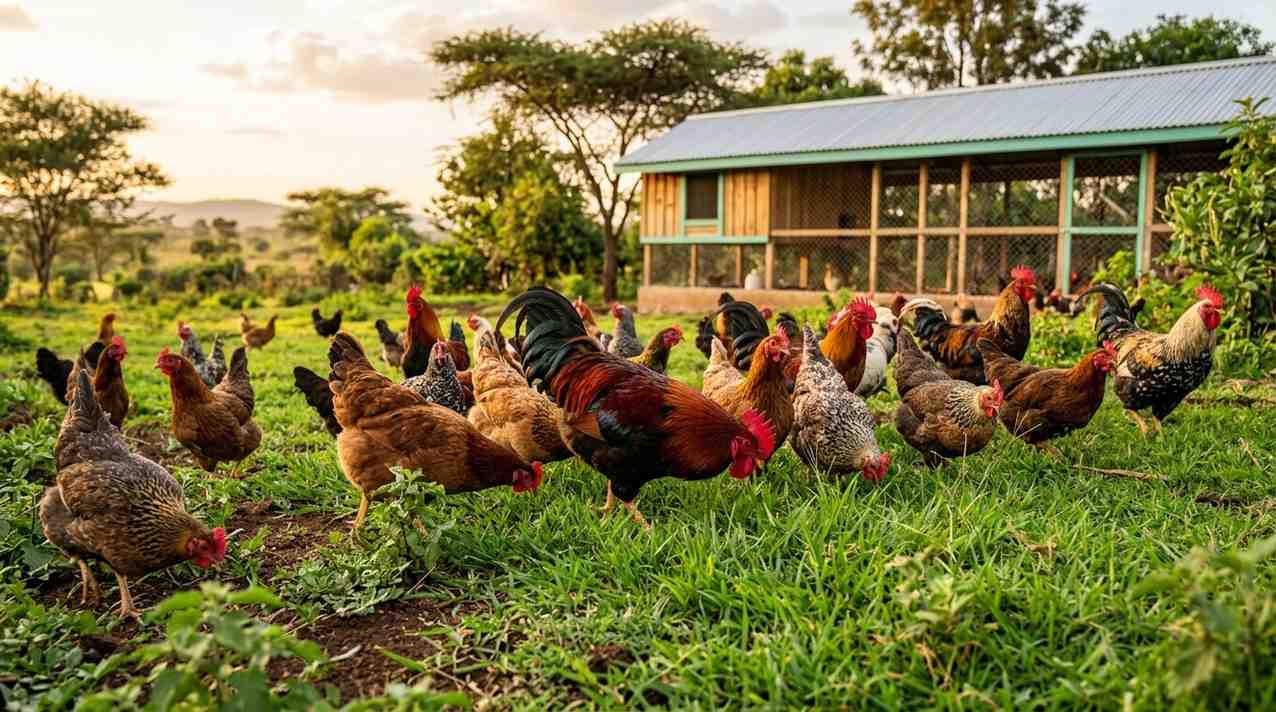
Poultry farming — especially improved kienyeji and Kenbro chicken — is one of Kenya's fastest-growing agribusinesses.
Avocado Farming in Kenya
Avocado farming in Kenya has become one of the country's most talked-about export crops. Kenya is now Africa's leading exporter of Hass avocados, shipping to the EU, Middle East, and Asia. Murang'a, Meru, Nyeri, and Kisii counties are the heartland of avocado farming Kenya, but the crop also grows well in Machakos, Embu, and parts of the Rift Valley above 1,200m altitude.
The Hass variety fetches the best export prices — KSh 15–40 per fruit at farm gate during peak demand — and a mature tree (over 5 years old) can yield 200–400 fruits per season. One acre holds approximately 100–120 trees, making per-acre earnings of KSh 200,000–500,000 realistic. Avocado farming Kenya is well suited to farmers who already grow other crops, since avocado is relatively low-maintenance once established.
The crop with highest profit per acre in Kenya argument often leads to avocados, garlic, or greenhouse capsicum. The key is securing a reliable off-taker — export firms such as Farm Concern International Kenya and Farm Africa Kenya work with smallholder farmers on export aggregation.
Greenhouse Farming in Kenya (Tomatoes, Capsicum & More)
Greenhouse farming in Kenya allows farmers to grow crops year-round, shield them from pests and unpredictable weather, and achieve yields 3–5 times higher than open-field farming. A standard 8m x 15m greenhouse in Kenya costs KSh 150,000–250,000 installed, while a larger 8m x 30m structure runs KSh 280,000–380,000.
The most popular crops in a greenhouse in Kenya are tomatoes (best varieties: Anna F1, Rambo F1, Tylka F1), capsicum (hoho farming), and cucumber. Tomato farming in Kenya in a greenhouse can yield 4–8 tonnes per quarter-acre per crop cycle, generating KSh 80,000–200,000 depending on market prices.
Horticultural farming in Kenya — particularly flowers for export — is dominated by large farms in Naivasha (Flower Farms in Naivasha, including Del Monte Kenya and the Delamere Farm Naivasha estate), but smallholders can profitably grow vegetables for domestic markets. Hoho farming in Kenya (capsicum) returns KSh 150,000–400,000 per quarter-acre per cycle in a well-managed greenhouse.
Other high-value greenhouse crops to consider include broccoli farming in Kenya, basil farming in Kenya, coriander farming (dania farming in Kenya), chives, asparagus, and courgette. These herbs and speciality vegetables command premium prices at Nairobi supermarkets and export markets.
Fish Farming in Kenya
Fish farming in Kenya is growing fast as wild fish stocks in Lake Victoria decline and urban demand for affordable protein rises. Tilapia and catfish farming in Kenya are the two most popular species. Tilapia is easier to manage and has a ready market, while catfish farming in Kenya commands a slight premium due to its flavour and longer shelf life.
A single earthen pond (10m x 20m) can hold 500–1,000 tilapia fingerlings and yield 300–600 kg of fish per cycle. At market prices of KSh 200–350 per kg for tilapia, that translates to KSh 60,000–200,000 gross per cycle. After feed costs (the biggest input), net profit ranges from KSh 30,000 to KSh 100,000 per cycle.
Counties around Lake Victoria — Kisumu, Migori, Homabay — as well as Meru, Kirinyaga, and Nakuru have well-established fish farming communities. The government's Ministry of Agriculture and Apollo Agriculture Kenya have supported fish farmers with inputs and market linkages.
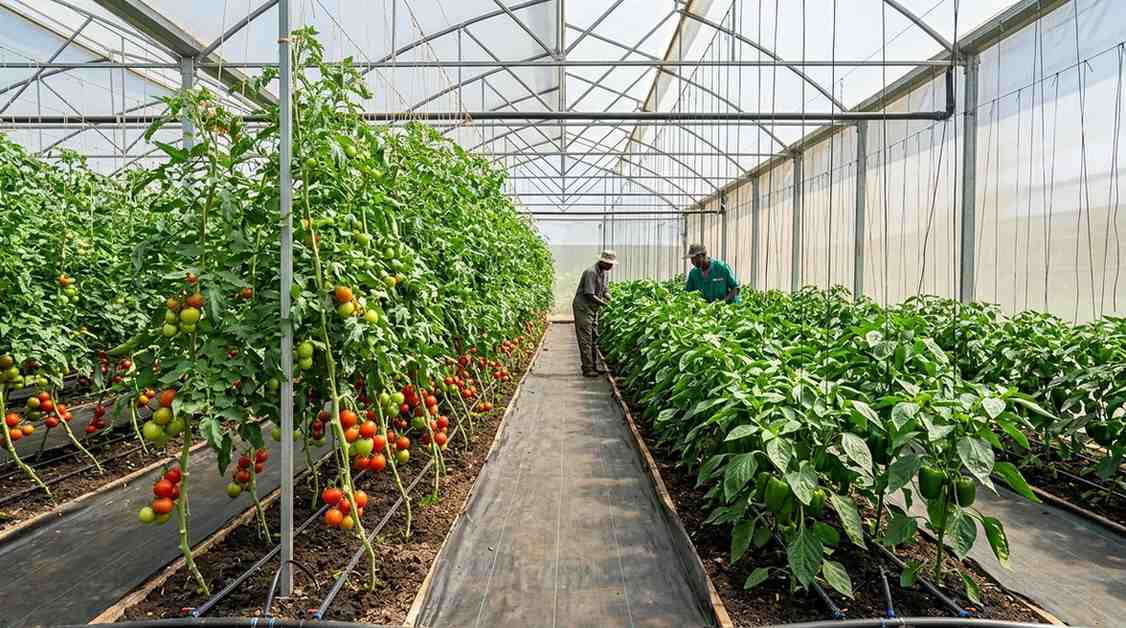
Greenhouse farming in Kenya enables year-round vegetable production with yields 3–5× higher than open-field farming.
Coffee Farming in Kenya
Coffee farming in Kenya produces some of the world's most sought-after arabica coffee. Kenya AA and AB grades regularly fetch premium prices on international auction markets. Smallholder coffee farmers in Kiambu, Murang'a, Kirinyaga, and Nyeri counties sell through cooperatives that market the beans at the Nairobi Coffee Exchange.
An established coffee acre under good management yields 800 kg–2,000 kg of cherry per year. After processing, that translates to 160–400 kg of export-grade green beans, earning KSh 80,000–300,000 per acre. Direct-to-roaster marketing (bypassing the auction) can double or triple these earnings for progressive farmers.
The Direct Settlement System introduced by the government has improved farmer payments, and platforms like Apollo Agriculture Kenya now offer crop insurance and input credit to coffee farmers.
Mushroom Farming in Kenya
Mushroom farming in Kenya is one of the best small-space, low-capital farming ventures available. You can grow oyster or button mushrooms in a spare room, a shipping container, or a modest shed. The business requires no farm land and can be run entirely in an urban setting.
Production cycles are short — oyster mushrooms fruit within 3–5 weeks of inoculation — and fresh mushrooms retail at KSh 300–700 per kg in Nairobi supermarkets, hotels, and restaurants. With 200 substrate bags producing 0.5 kg each, you can gross KSh 30,000–70,000 per cycle. Substrate materials (wheat straw, sawdust, cotton waste) are cheap and locally available.
The Kenya Institute of Organic Farming (KIOFA) and various NGOs offer low-cost training on mushroom cultivation. Mushroom farming pairs well with organic farming in Kenya since chemical inputs are not required.
Garlic Farming in Kenya
Garlic farming in Kenya is frequently cited as one of the most profitable crops per acre in the country. Kenya imports large quantities of garlic from China, which means local production has a ready, guaranteed market. A single acre of well-managed garlic yields 1,500–3,000 kg of dry bulbs. At farm-gate prices of KSh 150–200 per kg, gross earnings range from KSh 225,000 to KSh 600,000 per acre per cycle.
The main costs are seed garlic (KSh 200–350/kg), fertiliser, labour, and irrigation. Net profits for an organised smallholder can reach KSh 250,000–400,000 per acre, making garlic one of the crops with the highest profit per acre in Kenya.
Best varieties include Khetabi (Creole), Italian Purple, and Chinese White. Nyandarua, Meru, Laikipia, and parts of the Rift Valley provide the cool-to-moderate temperatures and well-drained soils that garlic prefers.
Dragon Fruit Farming in Kenya
Dragon fruit farming in Kenya is a relatively new but rapidly growing venture. The cactus-like plant (Hylocereus species) thrives in semi-arid and warm coastal regions — making it ideal for Kilifi, Kwale, Machakos, Makueni, and Kajiado counties. It is drought-tolerant, requires minimal water once established, and can produce fruit for 20+ years.
A mature dragon fruit plant yields 20–30 kg of fruit per year. At KSh 300–800 per kg (fresh market), one acre with 400 plants can earn KSh 2.4 million–9.6 million per year at full maturity. Even in early years, earnings of KSh 150,000–500,000 per acre are achievable. The crop has growing demand from Nairobi supermarkets, high-end hotels, and health-food exporters.
Key challenges include sourcing genuine cuttings and finding off-takers. Connecting with bizna Kenya farming networks and the Ministry of Agriculture extension officers in your county will help secure the right variety and market.
Goat Farming in Kenya
Goat farming in Kenya is highly versatile. Goats are hardy, low-cost to keep, and have a diverse market — for meat, milk, and breeding stock. Popular breeds include the Boer goat in Kenya (for meat), the Galla goat (indigenous, resilient, good meat), and dairy goats in Kenya such as the Toggenburg, Alpine, and Saanen breeds.
Dairy goat farming in Kenya is growing especially fast in drier regions like Meru, Machakos, and Kajiado, where cattle keeping is difficult. A dairy goat Kenya costs KSh 10,000–25,000 and produces 1–4 litres per day. Goat milk fetches KSh 80–150 per litre — significantly more than cow's milk — and has a growing market among health-conscious consumers. For meat, a mature Boer cross goat sells for KSh 8,000–20,000.
More High-Potential Farming Opportunities in Kenya
11. Maize Farming in Kenya
Maize farming in Kenya remains the backbone of food production, with Kenya's staple ugali driving constant demand. An acre of maize yields 10–25 bags (90 kg each) depending on rainfall and inputs. At KSh 3,000–4,500 per bag, a good acre earns KSh 30,000–112,000 per season. Hybrid seeds (DK8031, H614D) and smart input use through platforms like Apollo Agriculture Kenya can significantly boost yields. Two seasons per year are possible with irrigation.
12. Irish Potato Farming in Kenya
Irish potato farming in Kenya (also called potato farming in Kenya) is most productive in cool highland counties — Nyandarua, Meru, Kericho, Nakuru, and Nyeri. One acre yields 80–200 bags of potatoes (50 kg each). With farmgate prices at KSh 800–2,500 per bag, earnings range from KSh 64,000 to KSh 500,000 per acre. The main challenge is the late-blight fungus, which requires proper fungicide management and disease-resistant varieties like Shangi, Markies, and Dutch Robjin.
13. Tomato Farming in Kenya
Tomato farming in Kenya is one of the most dynamic vegetable businesses. Kenya produces approximately 300,000 tonnes of tomatoes annually, yet demand consistently outstrips supply. The best tomato varieties in Kenya for open-field production include Tylka F1, Anna F1, and Rambo F1. For greenhouse production, Climstar F1 and Faulu F1 are popular. A quarter-acre of open-field tomatoes can yield 4–6 tonnes, generating KSh 60,000–150,000 per cycle. Disease management (especially bacterial wilt and early blight) is the primary challenge.
14. Bee Farming (Apiculture) in Kenya
Apiculture in Kenya — or bee farming in Kenya — is a low-input, high-return venture suited to arid and semi-arid areas with diverse flowering plants. One Langstroth hive yields 15–30 kg of honey per harvest (2–3 harvests per year). At KSh 500–1,200 per kg for pure natural honey, a 10-hive apiary can generate KSh 150,000–360,000 per year. Coast, Eastern, and Rift Valley counties have ideal conditions. Bee wax, propolis, and royal jelly provide additional income streams.
15. Hydroponic Farming in Kenya
Hydroponic farming in Kenya — and the broader category of vertical farming in Kenya — is gaining traction in urban centres. Hydroponics in Kenya uses no soil and up to 90% less water than conventional farming, making it ideal for Nairobi, Mombasa, and Kisumu where land is expensive. Lettuce, kale, spinach, basil, and herbs are the most popular hydroponic crops. A 50-square-metre hydroponic setup (NFT or DWC system) can yield 100–200 kg of greens per month, earning KSh 40,000–120,000 at premium market prices. Initial setup costs range from KSh 80,000 to KSh 300,000 depending on system sophistication.
16. Banana Farming in Kenya
Banana farming in Kenya is a perennial earner in Meru, Kisii, Murang'a, and coastal counties. Tissue-culture (TC) banana varieties — such as Williams, Grand Nain, and Giant Cavendish — are widely promoted because they are disease-resistant and high-yielding. TC banana plants reach first harvest in 9–12 months and continue producing for 3–5 years on the same stool. One acre of TC bananas can produce 15–30 tonnes per year, earning KSh 120,000–300,000 at KSh 8–15 per kg (wholesale). The Ministry of Agriculture subsidises TC banana seedlings through selected nurseries.
17. Onion Farming (Bulb Onion) in Kenya
Bulb onion farming in Kenya and onion farming in Kenya more broadly are highly profitable where irrigation is available. The best onion varieties in Kenya for dry-matter content and shelf life include Red Creole, Bombay Red, and Red Pinoy. An irrigated quarter-acre of onions yields 2–4 tonnes per season. At KSh 30–80 per kg (depending on seasonality), earnings range from KSh 60,000 to KSh 320,000 per quarter-acre. Kajiado, Narok, Taita Taveta, and the Tana River basin are top production areas.
18. Organic Farming in Kenya
Organic farming in Kenya targets the fastest-growing food segment — health-conscious consumers and export markets that demand chemical-free produce. Certified organic vegetables, herbs, and grains fetch 30–80% price premiums over conventional equivalents at Nairobi's Zucchini, Carrefour, and speciality health shops. The Kenya Institute of Organic Farming (KIOFA) provides training, input access, and market linkages. Organic certification (from bodies like KEBS or Ecocert) takes 2–3 years but permanently elevates your pricing power.
19. Sunflower Farming in Kenya
Sunflower farming in Kenya is a low-maintenance cash crop with a guaranteed buyer in cooking-oil processors like Bidco Africa, Kapa Oil Refineries, and Pwani Oil. An acre of sunflower requires just KSh 6,000–10,000 in inputs and yields 700–1,200 kg of seed. At KSh 35–55 per kg, earnings range from KSh 25,000 to KSh 66,000 per acre. While the margins are modest, sunflower is drought-tolerant, fits well as a rotation crop, and improves soil structure — making it an excellent companion to other ventures.
20. Smart Farming and Vertical Farming in Kenya
Smart farming in Kenya combines technology — sensors, drones, satellite imagery, AI-driven crop advisory, and digital finance — with modern agronomy. Apollo Agriculture Kenya is the most prominent platform, providing smallholder farmers with satellite-based crop monitoring, tailored agronomic advice, and input credit repaid at harvest. Apollo Agriculture Kenya currently serves over 250,000 farmers across multiple counties.
Vertical farming in Kenya uses stacked growing layers in controlled environments to produce vegetables in small footprints — perfect for urban rooftops and warehouses. Coupled with hydroponic systems and LED lighting, vertical farms in Nairobi are producing lettuce, herbs, and microgreens for top restaurants at KSh 500–1,500 per kg. While capital requirements are high (KSh 500,000–2,000,000+), returns are similarly elevated for operators who secure premium restaurant and hotel supply contracts.
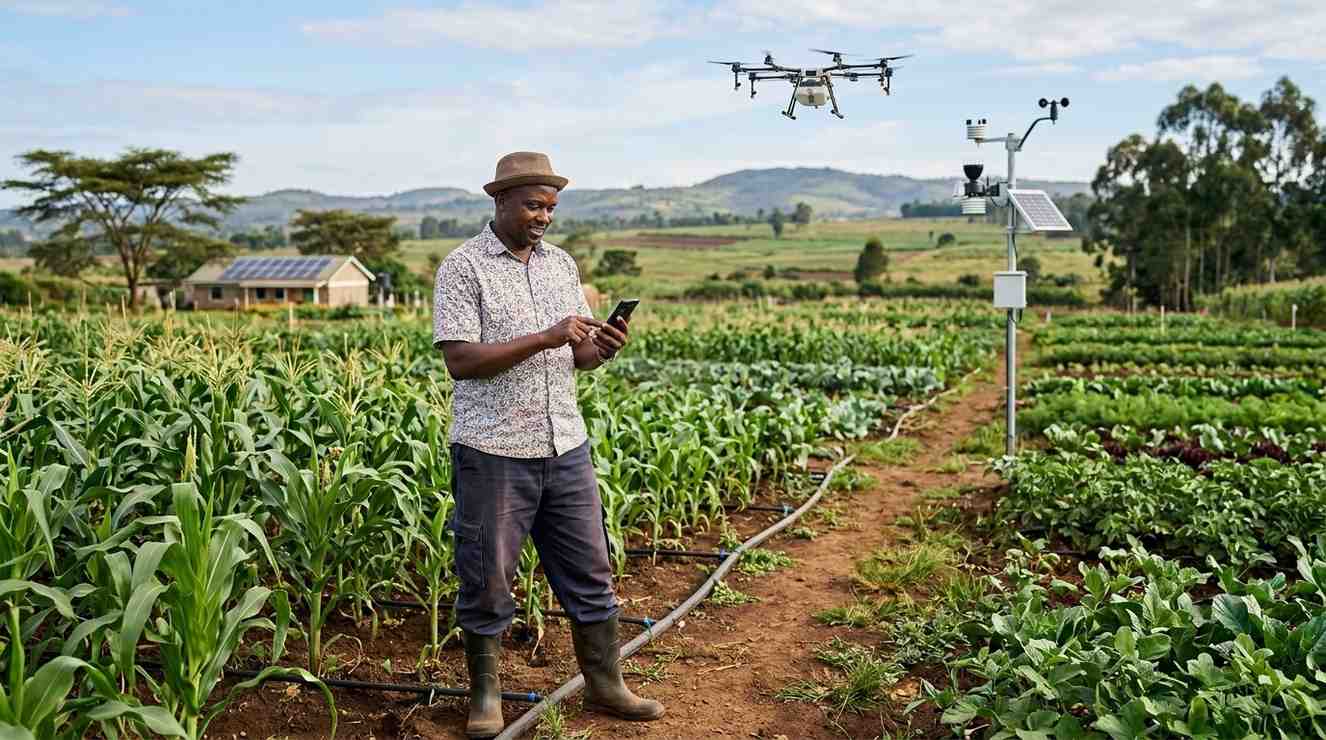
Smart farming platforms like Apollo Agriculture Kenya are helping thousands of Kenyan smallholders increase yields and access credit.
Other Notable Farming Opportunities in Kenya
Beyond the top 20, Kenya's diverse climate and soils support a wide range of other profitable farming ventures. Here is a quick overview of additional crops and livestock worth investigating:
Vegetable & Root Crops
Cabbage farming in Kenya is straightforward and fast (60–90 days to harvest), with an acre yielding KSh 60,000–180,000. Kale farming in Kenya (sukuma wiki) is one of the most consistent small-scale earners — popular kale varieties in Kenya include the Thousand-Headed and Collard. Carrot farming in Kenya yields 10–15 tonnes per acre (KSh 80,000–200,000). Beetroot farming in Kenya, brinjal (eggplant) farming in Kenya, butternut squash farming in Kenya, courgette farming in Kenya, and cucumber farming in Kenya are all strong greenhouse or irrigated-field crops.
Arrow root farming in Kenya (arrowroots / nduma) thrives in wetland margins of Central and Rift Valley counties. Cassava farming in Kenya is ideal for dryland Eastern and Coastal counties. Sweet potato and ginger farming in Kenya offer good margins, especially ginger, which can yield KSh 200,000–400,000 per acre.
Legumes & Grains
Bean farming in Kenya (including kamande/green gram farming in Kenya, dolichos beans, and grano peas farming in Kenya) fits well as an intercrop with maize. Green gram farming in Kenya is especially drought-tolerant, ideal for Kitui, Machakos, and Tana River. Groundnut farming in Kenya, barley farming in Kenya (for the malt industry in cooler highlands), and soybean farming are other profitable grain legumes.
Fruit & Tree Crops
Fruit farming in Kenya spans mangoes, citrus, passion fruit, watermelon, grapes (grape farming in Kenya is possible in parts of Rift Valley), apple farming in Kenya (apple fruit farming in Kenya is expanding in highland areas above 2,000m like Timau and Meru highlands), and cashew nut farming in Kenya (ideal for Kilifi and coastal lowlands). Bamboo farming in Kenya is a long-term investment with demand from construction, handicraft, and charcoal sectors.
Speciality & Industrial Crops
Cotton farming in Kenya is supported by the government's cotton revival programme. Canola farming in Kenya and castor farming in Kenya supply the growing biofuel and industrial oil sector. Chamomile farming in Kenya, aloe vera farming in Kenya, and herbal farming in Kenya tap into the natural health and cosmetics export market. Azolla farming in Kenya is increasingly used as a free-floating water fern for livestock and fish feed, cutting costs significantly.
Livestock & Other Animal Farming
Cow farming in Kenya beyond dairy includes beef farming in Kenya (Boran, Angus crosses). Hampshire sheep in Kenya and other exotic sheep breeds are a growing niche for meat and wool. Duck farming in Kenya, goose farming in Kenya, and black soldier fly farming in Kenya (for animal and fish feed production) are all emerging sectors. The animal feeds business in Kenya is itself a multi-billion-shilling industry with strong growth as livestock numbers rise.
Government, NGO & Tech Support for Kenya Agriculture
One of the biggest changes in Kenya agriculture over the last decade is the availability of support services for smallholder farmers:
- Apollo Agriculture Kenya — AI-driven crop advice, satellite monitoring, and input financing. Available in Bungoma, Kakamega, Kisumu, Trans Nzoia, and other counties. Visit apolloagriculture.com.
- Kenya Farmers Market — connects smallholder farmers to aggregators and buyers for fair prices.
- Farm Africa Kenya — supports smallholders with training, market linkages, and climate-smart practices across multiple counties.
- Farm Concern International Kenya — aggregates smallholder produce for export markets.
- Kenya Institute of Organic Farming (KIOFA) — training, certification support, and market access for organic farmers.
- Ministry of Agriculture — county extension officers provide free agronomic advice, subsidised seed and fertiliser through the e-voucher programme, and access to the Agricultural Finance Corporation (AFC) for loans.
- Agricultural Finance Corporation (AFC) — government-backed loans for farmers at concessional rates, including for livestock, equipment, and irrigation.
Also see our related guides on county-specific investment opportunities: Kakamega County Agriculture & Investment and Kiambu County's Economic Powerhouse for region-specific farming opportunities.
Frequently Asked Questions: Farming in Kenya
Which farming is most profitable in Kenya?
Dairy farming, poultry farming, avocado farming, garlic farming, and greenhouse horticulture are consistently among the most profitable. Garlic can return KSh 300,000–600,000 per acre, while mature Hass avocado orchards earn KSh 200,000–500,000 per acre per season. Dairy with a herd of 5+ grade cows can generate KSh 50,000–120,000 per month in milk sales alone.
How much capital do I need to start farming in Kenya?
You can start kienyeji chicken farming with as little as KSh 20,000–50,000 for 50 birds. A basic quarter-acre greenhouse costs KSh 150,000–250,000. Dairy farming with one grade cow starts from KSh 120,000–180,000. Fish farming in a single pond starts from KSh 80,000–150,000. Start small, learn the venture, and scale up with profits.
What is the best crop to grow in Kenya for profit?
Garlic, avocado, dragon fruit, coffee, capsicum (hoho), and Irish potatoes are among the highest-earning crops. The best choice depends on your region's climate, access to water, and market linkages. Greenhouse crops offer the highest per-acre returns regardless of region.
Is smart farming available in Kenya?
Yes. Smart farming in Kenya is growing rapidly, led by Apollo Agriculture Kenya, which provides AI-driven crop advice and satellite monitoring to smallholders. Digital platforms, mobile-based weather alerts, and e-voucher subsidy programmes are all widely available. Hydroponic and vertical farming is also expanding in urban centres.
Can I grow dragon fruit in Kenya?
Yes. Dragon fruit farming in Kenya thrives in semi-arid, warm regions like Machakos, Makueni, Kilifi, and the Coast. A mature plant yields 20–30 kg per year and fetches KSh 300–800 per kg. One acre can earn KSh 150,000–500,000+ per year once established.
What crops grow best with hydroponics in Kenya?
Lettuce, kale, spinach, capsicum, tomatoes, basil, coriander, and chives grow well in hydroponic systems in Kenya. Hydroponic farming uses up to 90% less water than soil farming and is ideal for urban or peri-urban settings with limited land.
Where can I get farming training in Kenya?
The Kenya Institute of Organic Farming (KIOFA), county extension officers (Ministry of Agriculture), Apollo Agriculture Kenya, Farm Africa Kenya, and various NGOs offer free or subsidised farming training. Many YouTube channels and government e-extension platforms also provide practical video guides on specific crops and livestock management.
Final Thoughts: The Best Time to Start Farming in Kenya Is Now
Kenya's population is projected to reach 70 million by 2030. That means food demand will keep rising, urban consumers will keep paying premium prices for quality produce, and export markets will continue to grow. Whether you choose dairy farming in Kenya, poultry farming in Kenya, avocado farming, dragon fruit, mushroom farming, or smart hydroponics, the opportunity is real — and the window to capture first-mover advantage in some of these sectors is still open.
Start with what you can afford, learn from your first cycle, connect with a good cooperative or off-taker, and use technology where you can. The farmers who thrive in Kenya are not always the ones with the most land or money — they are the ones who learn fastest and adapt quickest.