
Kiambu County is the undisputed economic overachiever of Kenya's 47-county system. Nestled in the central highlands immediately north of Nairobi, this compact 2,538 km² county punches far above its size — accounting for 5.5% of Kenya's national Gross Value Added and recording a Gross County Product (GCP) of KSh 819.8 billion in 2024, according to the Kenya National Bureau of Statistics (KNBS). Only Nairobi itself outperforms it.
But raw numbers only tell half the story. Kiambu's economic dominance is the product of a rare convergence: fertile volcanic soils that have produced world-class tea and coffee for over a century, an industrial corridor anchored by Thika that contributes 8.4% of Kenya's entire manufacturing output, and a real estate market supercharged by Nairobi's relentless urban sprawl. Add to that a County Competitiveness Index 2024 ranking of second nationally, and you begin to understand why investors — local and international — keep turning their eyes northward.
This guide breaks down every pillar of Kiambu's economy: the data, the dominant sectors, the investment hotspots, and what the future holds for Kenya's most dynamic county outside the capital.
Sources: KNBS 2024 GCP Report; KIPPRA Policy Brief 2023/24; Ministry of Investments, Trade and Industry CCI 2024.
1. Geography & Strategic Positioning
Geography is Kiambu's first and most durable competitive advantage. The county shares a southern boundary with Nairobi — Kenya's commercial capital and the economic nerve centre of East Africa. Towns like Ruiru sit barely three kilometres from Nairobi's city limits, while Kiambu Town itself is only 20 km from the CBD. This proximity allows residents to access Nairobi's labour market, financial services, and infrastructure while benefiting from Kiambu's lower land costs and relative openness.
The county also borders Kajiado to the south, Machakos to the east, Murang'a to the north-east, Nyandarua to the north-west, and Nakuru to the west. This central location turns Kiambu into a natural logistics and supply-chain node — goods produced here can reach any major Kenyan market efficiently. The eight-lane Thika Superhighway, one of Kenya's most transformative infrastructure investments, terminates deep within Kiambu, slashing transit times and spurring both industrial and residential development along its entire 50 km corridor.
Elevation across the county's central highlands averages 1,500–2,100 metres above sea level, producing cool temperatures and bimodal rainfall that make it one of the most agriculturally productive zones on the continent. The same red-brown, friable clay soils that nurtured colonial-era coffee and tea estates continue to sustain multi-billion-shilling agricultural enterprises today.
2. Agriculture — The Deep-Rooted Foundation
Agriculture is Kiambu's oldest and most widespread economic activity, directly or indirectly employing 304,449 people and contributing 17.4% of county population income according to the Kiambu County Government. The county's higher labour productivity — above the national average — is partly driven by the organised structure of its agricultural value chains.
Tea
Kiambu hosts several KTDA-managed tea factories, with the Ndarugu factory (originally registered as KURI Tea Factory in 2002) among its flagship processors. The county's cool, misty highland climate in areas like Limuru and Githunguri produces teas with the high polyphenol content prized by European buyers. Tea estates in Kiambu remain among the most productive per hectare in Kenya, contributing significantly to Kenya's position as the world's largest black tea exporter.
Coffee
Kiambu coffee — particularly varieties grown in Ruiru, Githunguri, and Kiambaa — commands premium prices in speciality markets. The county was historically the cradle of Kenya's coffee industry, and ongoing reforms championed by the Kenya Institute for Public Policy Research and Analysis (KIPPRA) aim to strengthen the coffee value chain by improving factory-level processing and direct export access for cooperative societies.

Dairy, Horticulture & Emerging Crops
The dairy sector is substantial — over 2,100 cows are slaughtered weekly in Kiambu alone, alongside 600 sheep and goats, reflecting a mature livestock economy. Githunguri Dairy Farmers' Co-operative Society, famous for the Fresha brand, is one of Kenya's most successful farmer-owned dairy processors and is headquartered in Kiambu.
Horticulture is a growing earner. Pineapples are produced at scale in Gatundu North and South constituencies, while avocados, bananas, and a rising herbs-and-spices sector are diversifying farm incomes. Innovative farmers report earning up to KSh 240,000 per month from a quarter-acre of herbs — returns that dwarf traditional coffee yields. Aquaculture, hydroponics fodder production, and rabbit farming are also expanding, pointing to a dynamic, modernising agricultural base.
Kiambu Agriculture at a Glance
- Major cash crops: tea, coffee, pineapples, avocados, bananas
- Major food crops: maize, beans, Irish potatoes, vegetables
- 304,449 people employed directly or indirectly in agriculture
- Home of Fresha dairy brand (Githunguri Dairy Co-op)
- KTDA-managed tea factories including Ndarugu
- Growing herbs & spices sector with premium export potential
- Hydroponics and aquaculture adoption rising in peri-urban areas
3. Manufacturing — Thika's Industrial Engine
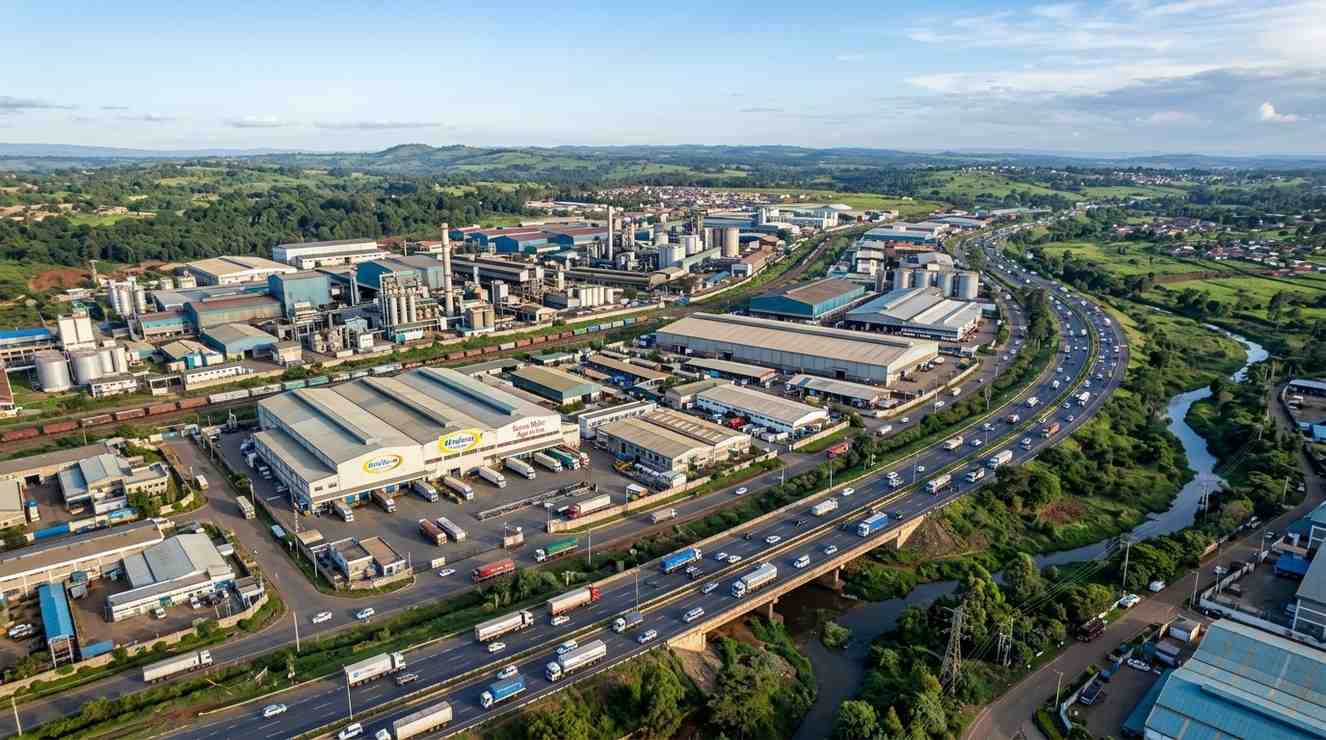
If agriculture is Kiambu's soul, manufacturing is its muscle. The county contributes 8.4% of Kenya's total manufacturing Gross Value Added — third nationally after Nairobi (36.9%) and Mombasa (9.9%). The bulk of this output is concentrated in Thika and Ruiru, two towns that have evolved into genuine industrial cities.
Thika Industrial Area houses some of Kenya's best-known manufacturers: food and beverage processors, textile factories (including Spinners & Spinners Garment Factory), steel mills (Devki Steel Mills), and animal feed companies (Ruiru Feeds). Pepsi-Cola has established a major bottling plant in the corridor, and global names like IKEA have scouted the area for logistics facilities.
The Thika Smart City & EPZ Initiative
In 2024, the Kiambu County Government announced a landmark KSh 10 billion investment to transform Thika into a smart industrial city. Central to this plan is a 325-acre Export Processing Zone (EPZ), officially gazetted to attract domestic and international manufacturers in agro-processing, textiles, and technology. The EPZ is projected to generate over 50,000 jobs — a figure that would meaningfully reshape the county's employment landscape.
The county has also partnered with the Japan International Cooperation Agency (JICA) on waste management at the Kang'oki dumpsite, integrating environmental sustainability into its industrial-city vision — a signal to ESG-conscious foreign investors that Kiambu is thinking long-term.
"The county has allocated 325 acres for the EPZ, expected to attract local and international investors in manufacturing, agro-processing, and technology."
— Kiambu County Government, 20244. Real Estate & Construction — The Urban Spillover Boom
Kiambu's real estate sector is arguably Kenya's most exciting property story outside Nairobi. Driven by population overflow from an increasingly congested and expensive capital, towns across Kiambu are undergoing a profound spatial transformation.
The county ranks second nationally in the 2024 County Competitiveness Index, with the Ministry of Investments, Trade and Industry specifically citing manufacturing, real estate, and construction as its key competitive drivers. Gated communities, industrial parks, and logistics hubs are rising across Thika, Ruiru, and Kikuyu, reshaping skylines and job markets in real time.
Key Investment Hotspots
| Town / Area | Key Driver | Asset Type | Outlook |
|---|---|---|---|
| Ruiru | 3 km from Nairobi; Tatu City; rail & road access | Residential, commercial, industrial | High Growth |
| Juja | JKUAT university town; Superhighway corridor | Student housing, retail, mixed-use | High Growth |
| Kikuyu / Thigio | Southern Bypass; close to Westlands & Upper Hill | Low-density residential, land banking | Emerging |
| Thika Town | EPZ, industrial park, Superhighway terminus | Industrial, warehouse, logistics | High Growth |
| Limuru | Cool climate, tea belt; highway access | Lifestyle estates, agricultural land | Steady |
| Kiambu Town | County HQ; 20 km from Nairobi CBD | Commercial, mixed-use, residential | Emerging |
The Tatu City Special Economic Zone in Ruiru — one of Africa's most ambitious private-sector urban development projects — is a bellwether for Kiambu's trajectory. With residential, commercial, industrial, and educational zones built to international standards, Tatu City is drawing multinationals and middle-class Kenyan families alike, validating the county's appeal as a destination of choice.
For buyers eyeing the Kenyan property market, resources like the KE Offers guide to major asset prices in Kenya can help contextualise the overall purchasing environment.
5. Services Sector — The Economy's Silent Majority
The services sector accounts for the highest share of Kiambu's Gross Value Added, led by wholesale and retail trade (particularly food, beverages, and tobacco), financial services, education, healthcare, and transport. Kiambu's high population density and its role as a dormitory county for Nairobi workers creates a robust consumer economy that sustains thousands of SMEs across all 12 sub-counties.
The county is also home to several universities and colleges — most notably Jomo Kenyatta University of Agriculture and Technology (JKUAT) in Juja — which generate economic activity, provide skilled labour, and attract technology-adjacent businesses. Logistics and transport are growing fast, with new warehousing and distribution centres clustering around the Superhighway corridor to serve the wider Nairobi Metropolitan Area.
For Kenyan entrepreneurs looking to leverage digital tools in this economy — from building an online business to creating a competitive web presence — KE Offers covers relevant infrastructure topics such as web hosting in Kenya and the best local hosting providers.
6. Labour Market & Productivity
One of Kiambu's most telling economic indicators is its labour productivity, which exceeds the national average, according to a KIPPRA Policy Brief (2023/24). This higher productivity is concentrated in the construction sector within the industry category, and in food manufacturing and textile production within the manufacturing sub-sector.
Employment breakdown reflects the county's economic structure: 75% of wage earners in the agricultural sector work in tea and coffee estates and horticulture. The self-employed segment spans construction companies, supermarkets, jua kali (informal) artisans, manufacturers, hotels, and bars — a diverse informal economy that acts as a social shock absorber and incubator for formal enterprise.
Looking for productivity tools to power a Kiambu-based business? KE Offers reviews the best laptops for online jobs in Kenya and the best value-for-money laptops to help workers and entrepreneurs stay competitive.
7. Investment Climate & Why Kiambu Wins
Kiambu is increasingly appearing on the radar of institutional investors, multilateral agencies, and private equity firms seeking exposure to Kenya's growth story outside the saturation of Nairobi's CBD. Several factors explain this momentum:
Why Investors Choose Kiambu
- Proximity to Nairobi: Access to Africa's third-largest city market without CBD costs
- Lower land prices relative to Nairobi, with strong capital appreciation potential
- EPZ tax incentives in Thika's newly gazetted 325-acre zone
- World Bank & JICA partnerships improving infrastructure and sustainability
- Skilled workforce — university town ecosystem (JKUAT, KCA University) supplies STEM talent
- Agri-processing potential — underutilised value chains in dairy, avocados, pineapples
- Strong SME ecosystem providing supply chain depth for anchor manufacturers
- Nairobi Metropolitan Area (NMA) planning framework integrating Kiambu's development
For those tracking Kenya's broader investment landscape, the World Bank's Kenya Country Profile and Kenya National Bureau of Statistics (KNBS) are authoritative starting points for macroeconomic data.
8. Challenges & Risks to Watch
No economic story is without its complications, and Kiambu faces real structural headwinds:
Land fragmentation and urbanisation pressure. Rapid population growth is converting productive agricultural land into residential estates. The same highland coffee farms that once defined Kiambu's identity are disappearing beneath gated communities — a trade-off that demands careful spatial planning to avoid permanently sacrificing productive capacity.
Environmental stress. Deforestation, degradation of water catchments, and encroachment on natural areas are documented challenges. The county straddles critical water towers that feed Nairobi's water supply, making sustainable land use not just a local but a national security issue.
High production costs. Kiambu manufacturers, like their Nairobi counterparts, face higher production costs than Asian competitors — a structural challenge that limits export competitiveness in price-sensitive global markets.
Infrastructure gaps in peripheral areas. While the Thika Superhighway corridor is well-served, more remote sub-counties like Lari, Gatundu North, and Gatundu South still face inadequate road networks and intermittent power supply that limit economic diversification.

9. Future Outlook — What's Next for Kiambu?
The 2023–2027 Kiambu County Integrated Development Plan (CIDP) — anchored in Kenya's Vision 2030 and aligned with the national Bottom-Up Economic Transformation Agenda (BETA) — lays out a road map centred on agro-industrialisation, infrastructure, and inclusive growth.
Key commitments include completing coffee reforms to help cooperative societies capture more value from farmgate to export; establishing a Micro, Small and Medium Enterprise (MSME) Aggregation Industry Park to boost the productivity of informal enterprises; and investing in health, education, and road infrastructure across all 12 sub-counties.
The Thika EPZ, if it delivers on its 50,000-job promise, would represent a generational leap for the county's manufacturing base. Paired with growing interest from logistics companies drawn to the Nairobi Metropolitan Area's expanding industrial real estate market — in which Kiambu accounts for a significant share of the roughly 90% NMA contribution to national industrial space — the outlook is decidedly optimistic.
On the technology front, Kiambu's proximity to Nairobi's Silicon Savannah (Westlands and the iHub ecosystem) and the presence of JKUAT's engineering graduates create conditions for tech-enabled agribusiness and manufacturing startups to take root. KE Offers covers the digital tools that support Kenya's growing online economy, from web hosting guides to the best laptop deals in Nairobi.
Stay Ahead of Kenya's Economic Landscape
From county economic guides to the best tech deals and investment primers — KE Offers keeps you informed and ready to act.
Explore All Guides →