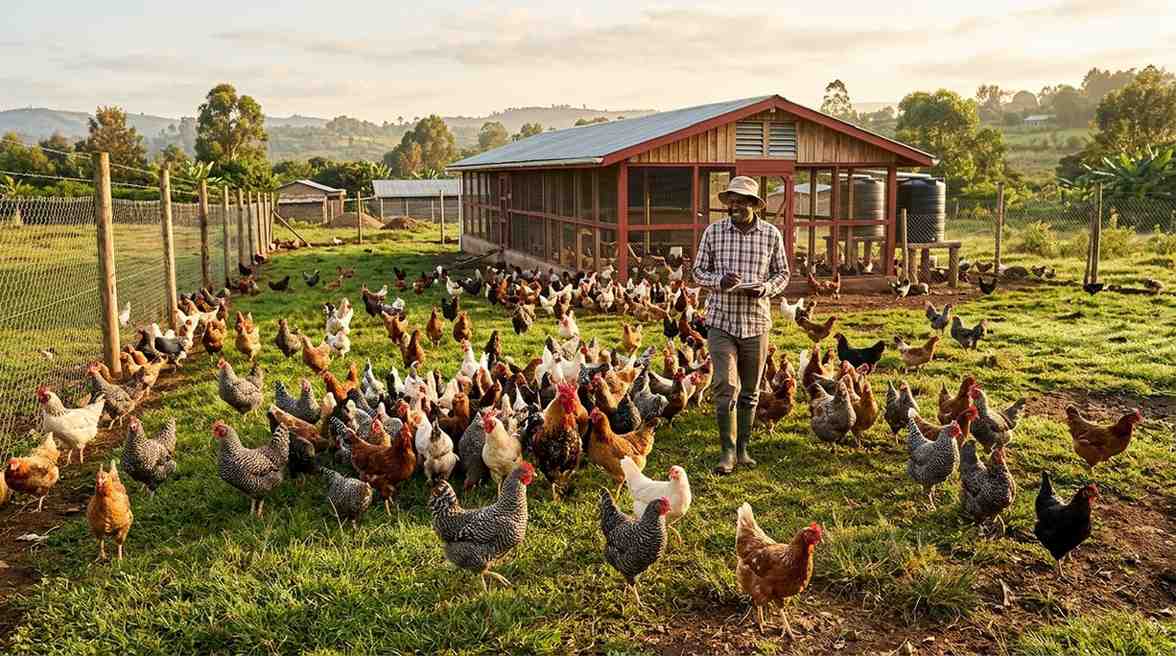
Why Improved Kienyeji Chicken?
Improved Kienyeji Chicken are special crossbred chickens that grow faster, lay more eggs, and are hardier than ordinary local chickens. A beginner in Kenya can start with 50 chicks for around KSh 30,000–50,000, and earn back profits within 4–6 months through meat sales, egg sales, or both.
What Is Improved Kienyeji Chicken?
Improved Kienyeji Chicken farming in Kenya is gaining popularity very fast — and for good reason. But first, what exactly is an "Improved Kienyeji" chicken?
The word kienyeji is a Swahili word that simply means "local" or "indigenous." Traditional Kienyeji chickens are the ordinary chickens that have roamed Kenyan homesteads for generations. They are tough, they can find their own food, and they have a delicious flavour that Kenyans love. But they are also very slow to grow and lay very few eggs.
Improved Kienyeji Chicken is a special crossbreed. Scientists and breeders combined the best traits of local Kenyan chickens with fast-growing, high-laying chicken breeds from other countries. The result is a bird that:
- Tastes just like traditional Kienyeji chicken
- Grows 2–3 times faster than ordinary local chickens
- Lays significantly more eggs per year
- Is much more resistant to common diseases
- Can survive on locally available feeds
Why Start Improved Kienyeji Chicken Farming?
Kenya has a huge and growing demand for chicken meat and eggs. People in cities, towns, and rural areas buy chicken every single day. At the same time, most Kenyans prefer the taste and texture of Kienyeji chicken over broiler (factory) chicken. That means Improved Kienyeji Chicken commands a higher price in the market than ordinary broilers.
Here are the top reasons why this business makes great sense:
✅ Advantages
- Low start-up capital needed
- High market demand always
- Better prices than broilers
- Shorter production cycle vs. local chicken
- Dual-purpose: meat AND eggs
- Hardy and disease-resistant
- Can do free-range or semi-intensive
❌ Challenges
- Needs proper feeding to do well
- Vaccines are a must (cost involved)
- Predators can be a problem
- Feed prices change a lot
- Requires daily attention
Many Kenyans start this business on weekends and evenings while still holding their day jobs. It is a great way to earn extra income and eventually grow into a full business. You can also check our guide on other money-making ideas in Kenya to complement this venture.
Best Improved Kienyeji Chicken Breeds in Kenya
Not all Improved Kienyeji chickens are the same. Several breeds are popular in Kenya. Each has slightly different traits. Here is a simple breakdown:
KARI Improved Kienyeji (Rainbow Rooster)
Developed by Kenya Agricultural Research Institute. Grows to 1.5–2 kg in 3–4 months. Lays 200–220 eggs/year. Very adaptable to Kenyan conditions.
Kuroiler
Originated in India. Heavy bird (up to 3 kg). Lays 150+ eggs/year. Excellent for farmers who want both meat and eggs from the same bird.
Sasso
French breed. Fast-growing. Can reach 2–2.5 kg in 10–12 weeks. Has the classic Kienyeji taste. Popular with hotels and restaurants.
Kenbro
Kenyan crossbreed developed at the Kenya Poultry Centre. Very disease-resistant. Grows steadily. Good for beginners in harsh climates.
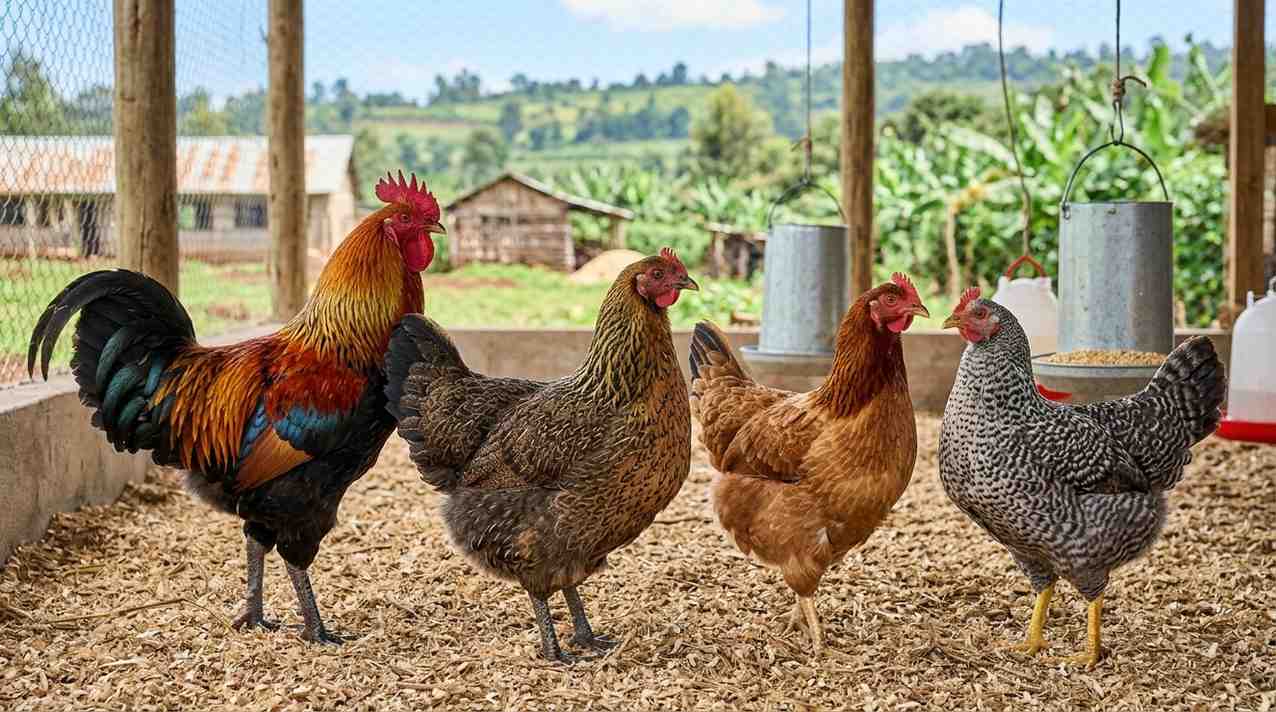
From left: KARI Improved Kienyeji, Kuroiler, and Sasso breeds — each suited for different farming goals.
Building a Chicken House (Poultry House)
Your chickens need a safe, clean, and comfortable house. A well-designed chicken house protects your flock from rain, cold nights, predators like mongooses and snakes, and diseases. You do not need an expensive building to start.
Basic Requirements for a Good Chicken House
- Size: Allow at least 0.09 m² (1 sq ft) per chicken. For 100 birds, build a house of at least 10 m².
- Ventilation: Windows with wire mesh on all sides to allow fresh air in and reduce ammonia from droppings.
- Flooring: Raised off the ground (earth floor with dry litter like sawdust or wood shavings works fine).
- Roofing: Iron sheets or tiles that keep the interior dry and cool.
- Perches and nests: Add wooden perches for roosting and nesting boxes for layers (1 box per 5 hens).
- Security: Strong wire mesh on windows and a lockable door to keep out predators.
Estimated Cost to Build a Basic Chicken House
| Item | Details | Estimated Cost (KSh) |
|---|---|---|
| Timber / poles | Frame and roof support | 3,000 – 6,000 |
| Iron sheets | 10–15 sheets for roof | 5,000 – 8,000 |
| Wire mesh | For walls and windows | 2,500 – 4,000 |
| Nails, hinges, wire | Hardware | 1,000 – 2,000 |
| Labour | Fundi (casual) | 3,000 – 5,000 |
| Total (50–100 birds) | KSh 14,500 – 25,000 | |
Feeding Your Improved Kienyeji Chickens
Feed is the biggest cost in chicken farming — it makes up about 60–70% of your total production cost. Getting feeding right is the most important thing you can do to make a profit.
Feeding Stages
Improved Kienyeji chickens have three main growth stages, and each stage needs a different type of feed:
| Stage | Age | Feed Type | Amount Per Bird / Day |
|---|---|---|---|
| Chicks | Day 1 – Week 4 | Chick Mash (22% protein) | 15 – 25 g |
| Growers | Week 5 – Week 8 | Growers Mash (18% protein) | 40 – 60 g |
| Finishers / Layers | Week 9+ | Finisher or Layers Mash (16%) | 80 – 120 g |
Tips on Feeding
- Always have clean, fresh water available. Chickens drink 2–3 times the weight of feed they eat.
- You can mix commercial feed with cheap local supplements like omena (dried dagaa fish), sunflower cake, or crushed maize.
- Allow your birds to free-range for part of the day — they will find insects, worms, and greens that reduce your feed bill.
- Do not feed chickens avocado, onions, salt, or mouldy food — these can kill them.
- Buy feed from trusted suppliers. Poor-quality feed leads to poor growth and higher mortality.
Health, Vaccines, and Disease Prevention
Even the hardiest Improved Kienyeji chicken can get sick if you don't take care of its health. The good news is that a simple and affordable vaccination schedule can protect most of your flock.
Recommended Vaccination Schedule
| Vaccine / Drug | When to Give | Disease Prevented | Cost (per 100 birds) |
|---|---|---|---|
| Newcastle (Lasota) | Day 7 & Day 21 | Newcastle Disease (ND) | KSh 150 – 300 |
| Gumboro (IBD) | Day 14 & Day 28 | Gumboro Disease | KSh 200 – 400 |
| Fowl Typhoid | Week 6 – 8 | Salmonella / Fowl Typhoid | KSh 200 – 400 |
| Newcastle booster | Every 3 months | ND (long-term protection) | KSh 150 – 250 |
| Dewormer | Every 3 months | Internal parasites | KSh 200 – 350 |
Signs of a Sick Chicken
- Drooping wings and sitting alone away from others
- Swollen eyes or discharge from the nose
- Diarrhoea (watery or bloody droppings)
- Not eating or drinking
- Sudden unexplained deaths in the flock
If you see any of these signs, isolate the sick bird immediately and call an agrovet or veterinarian as soon as possible. Kenya has many County Livestock Offices that offer free or low-cost advice.
Start-Up Costs: How Much Do You Need?
One of the most common questions beginners ask is: "How much money do I need to start Improved Kienyeji Chicken farming?" The honest answer is: it depends on your scale. But here is a realistic budget for a beginner starting with 50 chicks:
| Item | Details | Estimated Cost (KSh) |
|---|---|---|
| Day-old chicks (50) | At ~KSh 120–150 each | 6,000 – 7,500 |
| Chicken house (basic) | For 50 birds | 10,000 – 18,000 |
| Feed (0–8 weeks) | Chick + grower mash | 8,000 – 12,000 |
| Feeders & Drinkers | 5–8 units each | 1,500 – 2,500 |
| Vaccines & medication | Full schedule | 1,500 – 2,500 |
| Bulb / heat lamp | For brooding | 500 – 1,000 |
| Miscellaneous | Litter, disinfectants | 1,000 – 2,000 |
| Total Start-Up (50 birds) | KSh 28,500 – 45,500 | |
So realistically, KSh 30,000 – 50,000 is enough to start a proper 50-bird farm from scratch. If you already have land or an existing structure you can convert, your costs will be even lower.
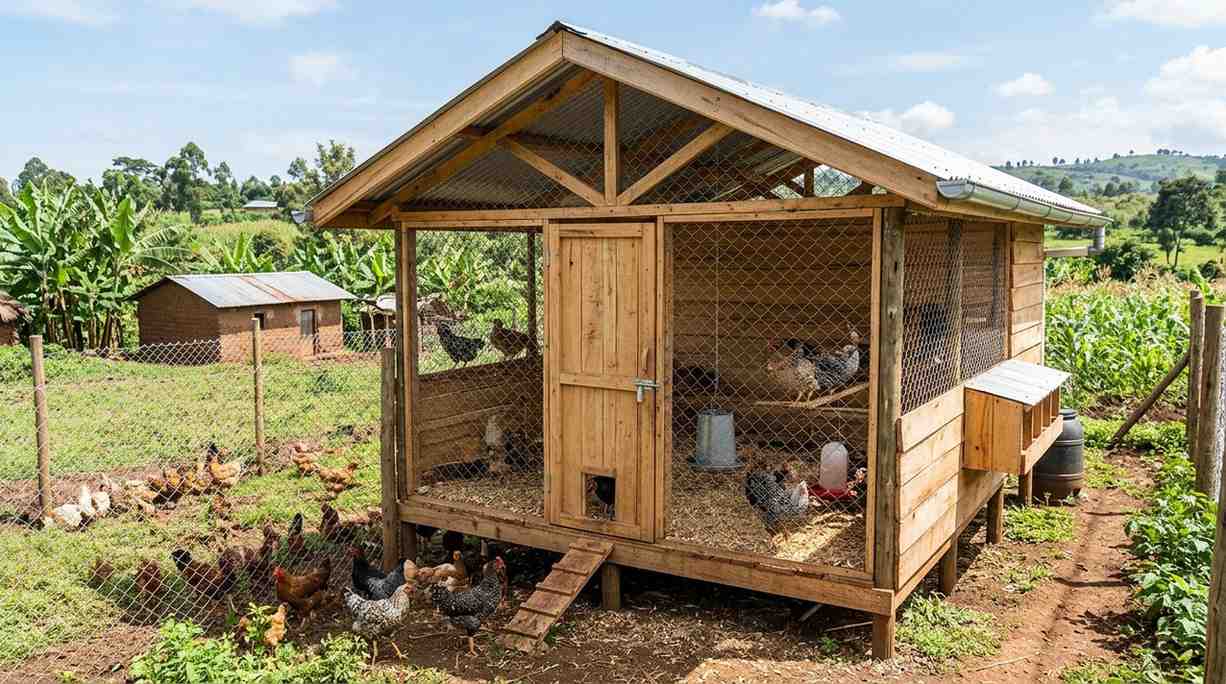
A simple but effective chicken house built with local materials — proof that you don't need a lot of money to get started.
How Much Profit Can You Make?
Let's do the numbers for a 100-bird Improved Kienyeji flock targeting the meat market (one production cycle of about 4 months):
Income
| Source | Details | Amount (KSh) |
|---|---|---|
| Chicken sales (meat) | 85 birds × KSh 800 avg (live weight) | 68,000 |
| Manure sales | Litter / organic manure | 1,500 |
| Total Income | KSh 69,500 | |
Costs (One Cycle)
| Expense | Amount (KSh) |
|---|---|
| 100 Day-old chicks | 13,000 |
| Feed (full cycle) | 22,000 |
| Vaccines & drugs | 3,000 |
| Labour (casual) | 3,000 |
| Utilities / misc | 1,500 |
| Total Costs | KSh 42,500 |
Where to Sell Your Improved Kienyeji Chickens
Finding buyers is not hard. Kenyans love Kienyeji chicken. The challenge is finding the right buyers who pay the best price. Here are your main options:
- Local market days: Sell live chickens at your nearest market. Easy but prices can be lower due to bargaining.
- Hotels and restaurants: Approach local hotels and restaurants directly. They prefer consistent supply and often pay more than market rates.
- Supermarkets: Some mid-size supermarkets in towns buy live or processed Kienyeji chicken. Requires consistency and sometimes a health certificate.
- WhatsApp groups and social media: Many farmers now sell directly to consumers via WhatsApp or Facebook. No middleman means better prices.
- Neighbours and church community: Word of mouth is powerful. Let people around you know what you sell.
- Processors and aggregators: Larger operations can supply to processors like those selling packaged chicken in towns.
Top Tips for Success in Improved Kienyeji Chicken Farming
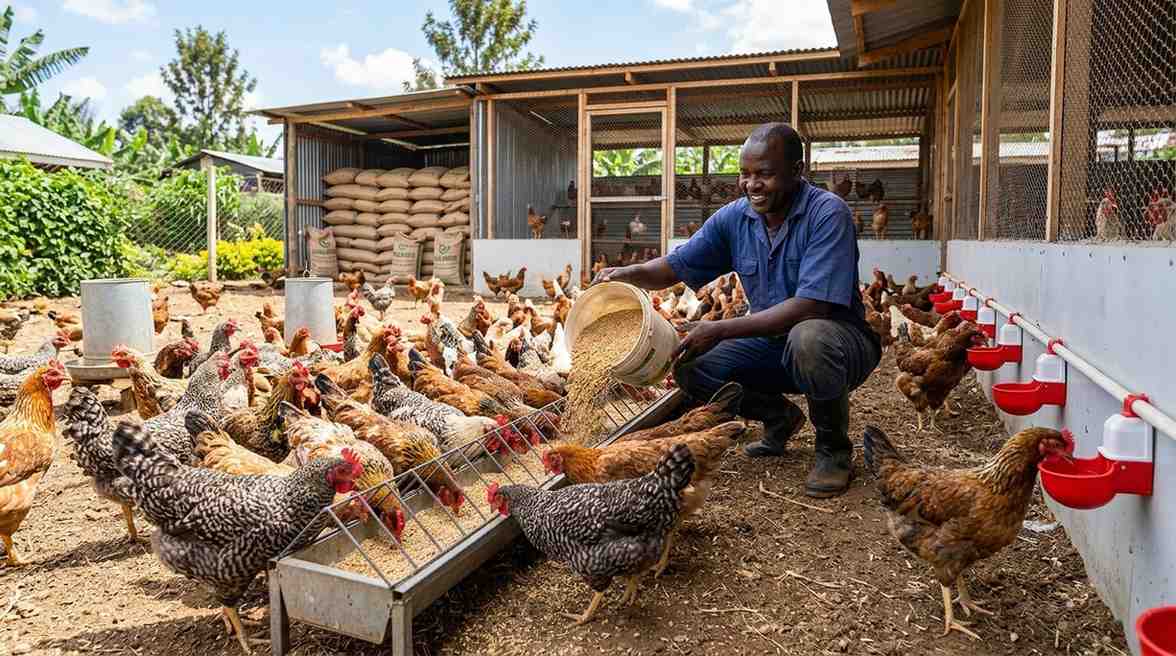
Regular inspection of your flock is one of the simplest and most effective ways to catch problems early.
From conversations with successful Kienyeji chicken farmers across Kenya, here are the most important lessons:
- Start small and learn first. Begin with 50–100 birds. Master the basics before scaling up to hundreds or thousands.
- Keep records. Write down every cost, every death, every sale. Records help you see where money is going and where you can improve.
- Never skip vaccines. Newcastle disease alone can wipe out your entire flock in days. The vaccine costs just a few hundred shillings — much cheaper than losing your birds.
- Buy quality chicks. Buy from certified hatcheries. Cheap chicks from unknown sources often come with diseases and poor genetics.
- Keep the house clean. Remove droppings regularly. Replace wet litter. Disinfect the house between cycles. Cleanliness prevents 80% of disease problems.
- Plan your market before you start. Know who will buy your birds and at what price before you even order your chicks.
- Join a farmers' group. Farmer cooperatives and groups help you buy inputs cheaply in bulk and sell at better prices together.
- Learn continuously. Follow trusted agricultural extension officers and visit organisations like KALRO (Kenya Agricultural & Livestock Research Organisation) for free learning resources.