Which are the best sectors to Invest in Kenya?
The best sectors to invest in Kenya are banking, telecoms, real estate (REITs), agriculture, insurance, manufacturing, and energy. Banking stocks like Equity and KCB consistently pay some of the highest dividends on the NSE. Telecom giant Safaricom offers steady growth. REITs give exposure to property without buying land.
This guide breaks down nine key investment sectors, explaining how each one works, what risks to watch out for, which companies are listed, and how each sector performs when the economy is booming or struggling. Whether you have Ksh 5,000 or Ksh 500,000 to invest, understanding these sectors is the first step to building real wealth.

The Nairobi Securities Exchange (NSE) lists companies across nine major investment sectors.
📋 Table of Contents
- Banking Stocks in Kenya
- Telecom Stocks on the NSE
- Insurance Stocks in Kenya
- Manufacturing Stocks in Kenya
- Agricultural Stocks in Kenya
- Energy Sector Shares
- Real Estate Investment Trusts (REITs)
- Which Sector Pays the Best Dividends?
- Best Defensive Sectors During Economic Slowdown
- Which Sectors Benefit From Inflation?
- Sector Comparison Summary
- Frequently Asked Questions
At a Glance: Kenya's Top Investment Sectors
Before we dive deep into each sector, here is a quick overview of how they stack up on the key things every investor cares about — growth potential, dividend income, and risk level.
| Sector | Dividend Yield | Growth Potential | Risk Level | Best For |
|---|---|---|---|---|
| Banking | 6–10% | High | Medium | Income + Growth |
| Telecoms | 5–7% | High | Low–Med | Stability + Growth |
| Insurance | 2–5% | Medium | Medium | Diversification |
| Manufacturing | 3–6% | Medium | Medium | Inflation hedge |
| Agriculture | 1–4% | Medium | High | Long-term growth |
| Energy | 4–8% | Medium | Medium | Income |
| REITs | 5–8% | Medium | Low–Med | Passive income |
| Consumer Staples | 3–5% | Low–Med | Low | Defensive holding |
Banking Stocks in Kenya Explained
Banking is the most popular investment sector on the NSE — and for good reason. Kenya has one of the most developed banking systems in Africa. Banks earn money from interest on loans, fees, forex trading, and mobile banking platforms. These multiple income streams make them resilient even when one part of the economy is struggling.
Kenya's biggest listed banks include:
- Equity Group Holdings (EQTY) — Kenya's largest bank by customer numbers, with over 20 million customers across East Africa. It also has a growing presence in DRC, Rwanda, Uganda, and Tanzania.
- KCB Group (KCB) — The largest bank by assets, with subsidiaries in Rwanda, Uganda, Tanzania, Burundi, South Sudan, and Ethiopia.
- NCBA Group (NCBA) — Known for M-Shwari and Fuliza mobile lending products in partnership with Safaricom. A strong digital banking play.
- Co-operative Bank (COOP) — Serves Kenya's large cooperative movement, with a loyal customer base in SACCOs and farming communities.
- ABSA Bank Kenya (ABSA) — Part of the pan-African ABSA Group, with strong corporate and retail banking services.
- Standard Chartered Kenya (SCBK) — A premium bank serving corporates and high-net-worth individuals.
- HF Group (HFCK) — Specialises in mortgage and property financing.
- I&M Group (I&M) — A mid-tier bank with operations in Rwanda, Tanzania, and Mauritius.
Why Invest in Kenyan Banks?
Banks are required by the Central Bank of Kenya (CBK) to hold minimum capital levels, which gives them a safety floor that most other businesses do not have. They also benefit from Kenya's large unbanked population — as more Kenyans access formal finance, banks grow. The rise of mobile money and agency banking has extended their reach to rural areas at very low cost.
You should know about how the Central Bank of Kenya influences your everyday life — because CBK decisions on interest rates directly affect how profitable banks are. When the CBK raises rates, banks tend to earn more on loans.
If you want to buy shares in Kenyan banks, you will need a licensed stockbroker. Faida Investment Bank is a licensed NSE investment firm that helps Kenyans open a CDS account and start trading bank stocks from as little as Ksh 5,000.
🏦 Ready to Buy Banking Stocks on the NSE?
Faida Investment Bank is a licensed NSE broker that helps Kenyans invest in bank shares, dividend stocks, and more — simply and affordably.
Open an Account with Faida →Telecom Stocks on the NSE
The telecom sector in Kenya is essentially a one-company story: Safaricom PLC (SCOM). With over 43 million subscribers, M-Pesa mobile money, and Ethiopia's newest mobile network (Safaricom Ethiopia), Safaricom is the single most valuable company on the NSE — and one of the most valuable in all of Africa.
What Makes Safaricom Special?
Safaricom is not just a phone company. M-Pesa processes more digital transactions in Kenya than Visa and Mastercard combined. The company also earns from data, enterprise IT services, home fibre (M-PESA Home), and a growing fintech ecosystem. This diversity of income streams makes it one of the most resilient stocks on the NSE.
Safaricom has paid a dividend every year since listing on the NSE. The company distributes a very high percentage of its earnings to shareholders — making it one of the most consistent dividend payers in Kenya. To see the full history, read our detailed Safaricom dividend payout history.
| Metric | Safaricom PLC |
|---|---|
| NSE Ticker | SCOM |
| Subscribers | 43+ million |
| M-Pesa Users | 32+ million |
| Dividend Consistency | ★★★★★ |
| Growth Potential | ★★★★☆ |
| Defensive Quality | ★★★★★ |
Insurance Stocks in Kenya
Kenya's insurance sector is still growing fast. Insurance penetration in Kenya sits at around 2.7% of GDP — well below the global average of 7%. That gap means there is huge room for growth as more Kenyans buy life, health, motor, and property cover.
Listed Insurance Companies on the NSE
- Jubilee Holdings — Kenya's largest insurer, with operations in Uganda, Tanzania, Burundi, and Mauritius. Offers life, general, and medical insurance.
- Britam Holdings — A diversified financial services group offering insurance, asset management, and property. Britam also has operations in seven African countries.
- CIC Insurance Group — Specialises in the cooperative sector, with strong ties to SACCOs and agricultural communities.
- Liberty Kenya Holdings — Part of Standard Bank's insurance arm, Liberty Africa.
- Sanlam Kenya — Part of the South African Sanlam Group.
- Pan Africa Insurance — Focused on life insurance products.
Why Insurance Can Be a Smart Investment
Insurance companies collect premiums upfront and pay claims later. This gives them a large pool of cash — called a "float" — that they invest in government bonds, real estate, and shares. When investment returns are good and claims are low, insurance companies are highly profitable.
The sector also benefits from Kenya's growing middle class, increased health awareness after the COVID-19 pandemic, and government efforts to expand the National Health Insurance Fund (NHIF), which is now SHIF (Social Health Insurance Fund).
Manufacturing Stocks in Kenya
Kenya's manufacturing sector accounts for around 9% of GDP and is a focus area under Kenya's Vision 2030 development blueprint. Listed manufacturers on the NSE span beverages, cement, fast-moving consumer goods (FMCG), and industrial goods.
Key Manufacturing Companies on the NSE
- East African Breweries Limited (EABL) — The dominant beer and spirits maker in East Africa. Produces Tusker, Guinness, and Uganda Waragi, among others. EABL is majority-owned by Diageo, giving investors exposure to a global brand.
- BAT Kenya (BATK) — British American Tobacco's Kenya operation. One of the highest-yielding dividend stocks on the NSE despite long-term regulatory headwinds for the tobacco industry.
- Bamburi Cement (BAMB) — Part of the Holcim Group, Bamburi is Kenya's leading cement manufacturer.
- Crown Paints Kenya (BERG) — A paint and coatings manufacturer with distribution across East Africa.
- Unga Group (UNGA) — A large flour and animal feeds miller. Sells directly to consumers and businesses.
- Carbacid Investments (CARB) — A carbon dioxide and dry ice manufacturer. Supplies the beverage, food, and healthcare industries.
Manufacturing as an Inflation Hedge
Manufacturing companies can often pass rising input costs onto consumers by raising prices. This makes them a partial hedge against inflation, especially in the food, beverages, and building materials space. Companies like EABL and Unga Group benefit directly when food prices rise because they can charge more while keeping their margins.
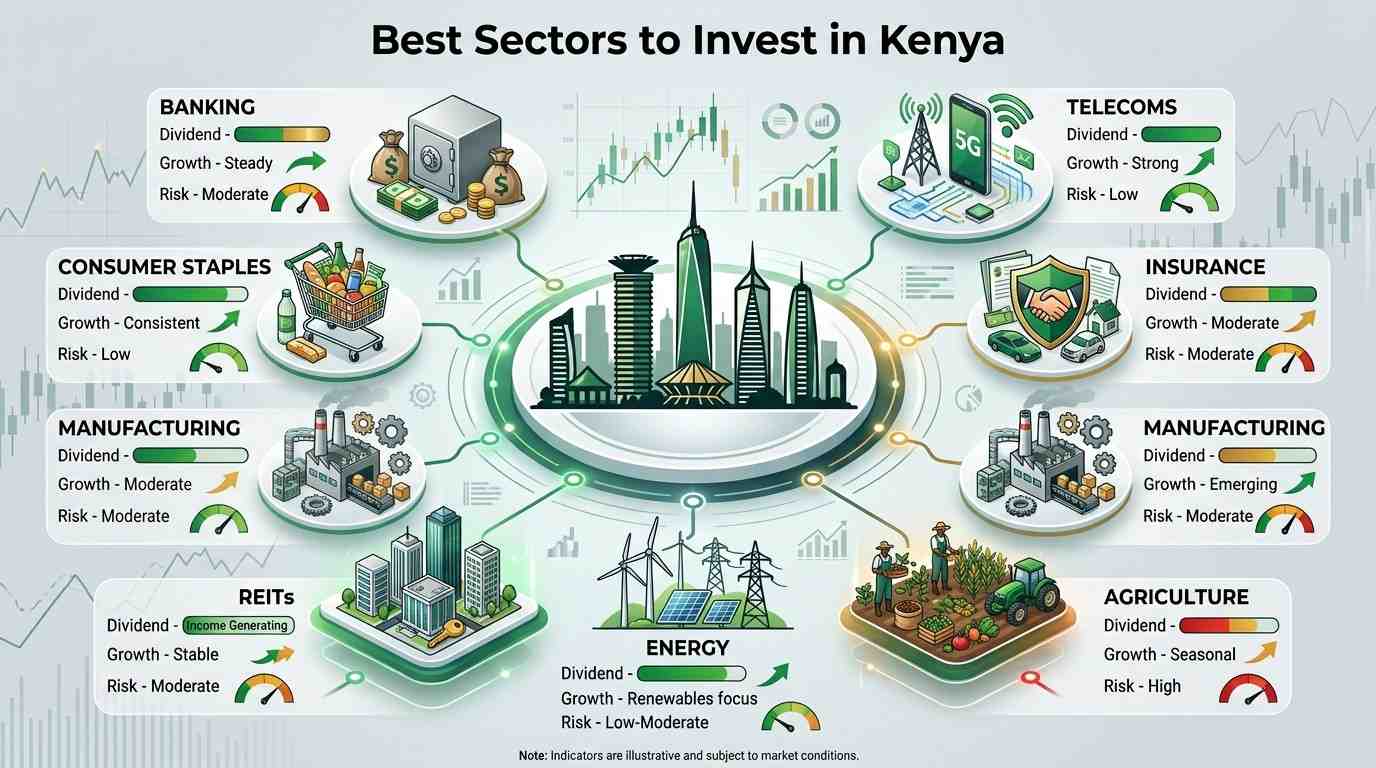
Kenya's growing economy offers investors multiple sectors to consider, from banking to real estate.
Agricultural Stocks in Kenya
Agriculture remains the backbone of Kenya's economy, contributing over 33% of GDP when you include food processing and related services. Several agricultural companies are listed on the NSE, giving investors exposure to tea, coffee, flowers, sugar, and dairy.
Key Agricultural Companies on the NSE
- Sasini PLC (SASN) — A diversified agribusiness with tea, coffee, and avocado farming operations. A good pick for investors who want exposure to export agriculture.
- Kapchorua Tea Kenya (KAPC) — Tea farming and processing in the Kericho highlands. Sells mostly to export markets.
- Williamson Tea Kenya (WTK) — Another Kericho-based tea producer, one of the oldest in Kenya.
- Limuru Tea Company (LIMT) — A smaller tea estate listed on the NSE.
- Eaagads Limited (EGAD) — Coffee growing and processing in Thika. A pure-play coffee stock.
- Mumias Sugar Company (MSC) — Mumias went through a major financial crisis and is under receivership. It is a high-risk, speculative play.
Agricultural Stocks and the Kenyan Weather Cycle
Agricultural stocks in Kenya are heavily influenced by weather. A good long rain season in Kericho or the Central Highlands means higher tea yields and stronger profits. Drought years hit output and profits hard. This makes agri-stocks more volatile than banks or telecoms, but patient investors who buy during drought years can benefit greatly when conditions improve.
For investors interested in the physical side of farming — not just shares — read our comprehensive guide on farming in Kenya: 20 top opportunities to exploit.
Energy Sector Shares Explained
Kenya has one of Africa's most impressive renewable energy mixes. Around 90% of Kenya's electricity comes from clean sources — geothermal, hydro, wind, and solar. This gives Kenya an energy advantage that supports economic growth while making the energy sector interesting from an investment standpoint.
Key Energy Companies on the NSE
- KenGen (KEGN) — Kenya Electricity Generating Company. Kenya's largest power producer, generating most of the country's electricity from geothermal fields in Olkaria, hydroelectric dams, and wind farms. KenGen is majority government-owned.
- Kenya Power (KPLC) — The sole distributor of electricity in Kenya. If KenGen makes the power, Kenya Power sells it to homes and businesses. Historically a high-dividend stock but has faced challenges with debt and transmission losses.
- Kenol/KenolKobil (now Rubis Energy Kenya) — A petrol station and fuel distribution network across East Africa, now part of the French Rubis Group.
- Total Energies Marketing Kenya (TOTL) — The local arm of TotalEnergies, one of the world's largest energy companies. Operates petrol stations and distributes LPG cooking gas.
Why the Energy Sector Matters to Investors
Electricity demand in Kenya is growing as the country urbanises, industrialises, and adopts electric vehicles. KenGen in particular has ambitious expansion plans — adding more geothermal capacity and even exporting power to Ethiopia and Tanzania through the Kenya Power grid. Energy stocks can provide steady income through dividends and benefit from Kenya's long-term electrification agenda.
Real Estate Investment Trusts (REITs) in Kenya
A Real Estate Investment Trust (REIT) lets you invest in large commercial properties — like malls, office buildings, or warehouses — without having to buy or manage any property yourself. You simply buy units of the REIT on the NSE, and the fund pays you a share of the rental income.
REITs Listed on the NSE
- ILAM Fahari I-REIT (FAHR) — Kenya's first listed REIT, managed by ICEA Lion Asset Management. It holds commercial properties including office blocks and retail spaces. By law, it must pay at least 80% of its distributable income to unit holders — making it a reliable income vehicle.
- Acorn D-REIT and I-REIT — Acorn Holdings introduced Kenya's first development REIT (D-REIT) focused on student housing. Its income REIT (I-REIT) holds completed student accommodation assets near Nairobi universities.
Why REITs Are Attractive for Kenyan Investors
Land prices in Kenya — especially in Nairobi, Mombasa, and Kisumu — continue to rise. But buying prime commercial real estate requires hundreds of millions of shillings. REITs democratise this asset class. An investor with Ksh 1,000 can own a piece of a Nairobi office block. REITs also provide regular income distributions, which makes them similar to fixed income without being as boring as government bonds.
If you are curious about where the best property opportunities are across Kenya, our guide on investing in Laikipia County explores how real estate is developing beyond Nairobi.
Which Sector Pays the Best Dividends in Kenya?
For investors who want regular income from their shares, dividend yield is the most important number. Here is how Kenya's main sectors compare on dividend payments:
| Sector | Top Payers | Typical Yield | Consistency |
|---|---|---|---|
| Banking | Equity, KCB, NCBA, COOP, ABSA | 6–10% | ★★★★★ |
| Telecoms | Safaricom | 5–7% | ★★★★★ |
| Energy | KenGen, Total Kenya | 4–8% | ★★★☆☆ |
| REITs | ILAM Fahari, Acorn I-REIT | 5–8% | ★★★★☆ |
| Manufacturing | EABL, BAT Kenya, Carbacid | 3–6% | ★★★★☆ |
| Insurance | Jubilee, Britam | 2–5% | ★★★☆☆ |
| Agriculture | Sasini, Kapchorua | 1–4% | ★★☆☆☆ |
The banking sector wins overall because it combines high yields with consistent payment history. Equity Bank in particular has an impressive track record — read our full Equity Bank dividend payout history to see exactly how much they have paid investors over the years.
If you want to calculate exactly how much dividend income you would receive from any NSE-listed stock based on how many shares you own, use the free NSE Dividend Calculator on KE Offers.
For investors who want to buy dividend stocks on the NSE, Faida Investment Bank can help you open a CDS account and start building your dividend portfolio today.
📈 Build Your NSE Dividend Portfolio
Faida Investment Bank is a trusted, licensed NSE broker. Whether you want banking, telecom, or REIT stocks — they make it easy to start investing with as little as Ksh 5,000.
Get Started with Faida Investment Bank →Best Defensive Sectors During an Economic Slowdown in Kenya
Not all sectors fall equally when Kenya's economy slows down. Defensive sectors are those that sell things people need no matter what — food, medicines, electricity, and communication. When the economy contracts, these sectors hold up much better than luxury goods or property development.
Top Defensive Sectors in Kenya
1. Consumer Staples (Food & Beverages) — Companies like EABL (beer), Unga Group (flour), and BAT Kenya (cigarettes) sell products that people buy in good times and bad. People may drink cheaper beer during a recession, but they still drink. These stocks tend to fall less and recover faster.
2. Utilities (Kenya Power, KenGen) — Electricity is not optional. Homes and businesses need it regardless of economic conditions. Utility stocks provide predictable revenue streams because demand is relatively constant.
3. Telecoms (Safaricom) — Mobile data, calls, and M-Pesa are daily necessities in Kenya. Even when budgets are tight, Kenyans will cut food before they cut mobile data. Safaricom's sticky customer base makes it one of the most defensive stocks on the NSE.
4. Healthcare — While there are few listed healthcare stocks on the NSE right now, this sector is inherently defensive. People get sick regardless of the economy. Keep an eye on this space as Kenya's healthcare investment ecosystem grows.
Understanding where Kenya lives and how people spend their money matters for this strategy. Our guide to the best neighborhoods in Nairobi for young professionals highlights the economic activity concentrated in the city's growth zones — which also tells you where consumer spending is most resilient.
Which Sectors Benefit From Inflation in Kenya?
Inflation in Kenya has been a persistent challenge for household budgets and businesses. But some investment sectors actually do well — or even thrive — when prices are rising. Understanding this can help you position your portfolio as a real inflation hedge.
1. Real Estate and REITs
When inflation rises, so do property values and rental income. REITs that hold income-generating properties pass higher rents directly to investors through distributions. Land in Nairobi and other major cities has historically appreciated faster than inflation — making real estate one of the most powerful inflation hedges available to Kenyans.
2. Agricultural Companies
Food inflation benefits agricultural companies because they can sell their produce — tea, coffee, sugar, milk — at higher prices. Farmers and agricultural processors often see their revenues jump during inflationary periods, even if input costs also rise. Companies with pricing power (the ability to raise prices) come out ahead.
3. Banking Sector
Banks benefit indirectly from inflation because the CBK typically responds to rising inflation by increasing the Central Bank Rate (CBR). Higher interest rates mean banks can charge more on loans. This widens their net interest margin — the gap between what they pay on deposits and what they earn on loans — which goes straight to profits.
4. Energy and Fuel Distributors
When global oil prices rise (a common trigger of inflation in Kenya), fuel distributors like Total Energies and Rubis Energy earn more per litre sold. KenGen and Kenya Power may also benefit if the government allows electricity tariff increases to match rising costs.
5. Manufacturing (Selective)
Manufacturers with strong brands — like EABL with Tusker or Bamburi with cement — can pass price increases to consumers. Those without pricing power (commoditised products) may struggle as input costs rise faster than output prices.
Complete Sector Comparison: How to Choose What's Right for You
Your ideal sector mix depends on three things: how long you plan to invest, how much risk you can handle, and whether you want regular income or long-term capital growth. Here is a fuller comparison to help you decide.
| Sector | Inflation Shield | Defensive? | Dividend Yield | Best Holding Period |
|---|---|---|---|---|
| Banking | Yes | Partial | 6–10% | 3–10 years |
| Telecoms | Partial | Yes | 5–7% | 5–15 years |
| Insurance | Limited | Partial | 2–5% | 5–10 years |
| Manufacturing | Yes | Partial | 3–6% | 3–10 years |
| Agriculture | Yes | No | 1–4% | 5–15 years |
| Energy | Yes | Partial | 4–8% | 5–15 years |
| REITs | Yes | Partial | 5–8% | 3–10 years |
A well-balanced Kenyan investor might hold something like 40% banking, 20% telecoms, 15% energy or REITs, 15% manufacturing, and 10% agriculture. This gives you strong dividend income, inflation protection, and some exposure to growth sectors — while keeping risk manageable.