Questions on investing in Kenya flood Google every single day — and most beginners never find clear, honest answers. This guide changes that. We have gathered 100+ of the most-asked investing questions from Kenyans of all income levels, grouped them into easy sections, and answered every single one. Whether you are a university student with Ksh 1,000, a working parent with Ksh 50,000, or a professional looking to build serious wealth, you will find answers here.
We cover everything: how to start, NSE shares, Money Market Funds, Treasury Bills, real estate, passive income, investment comparisons, risk management, and wealth building strategies that actually work in the Kenyan market.
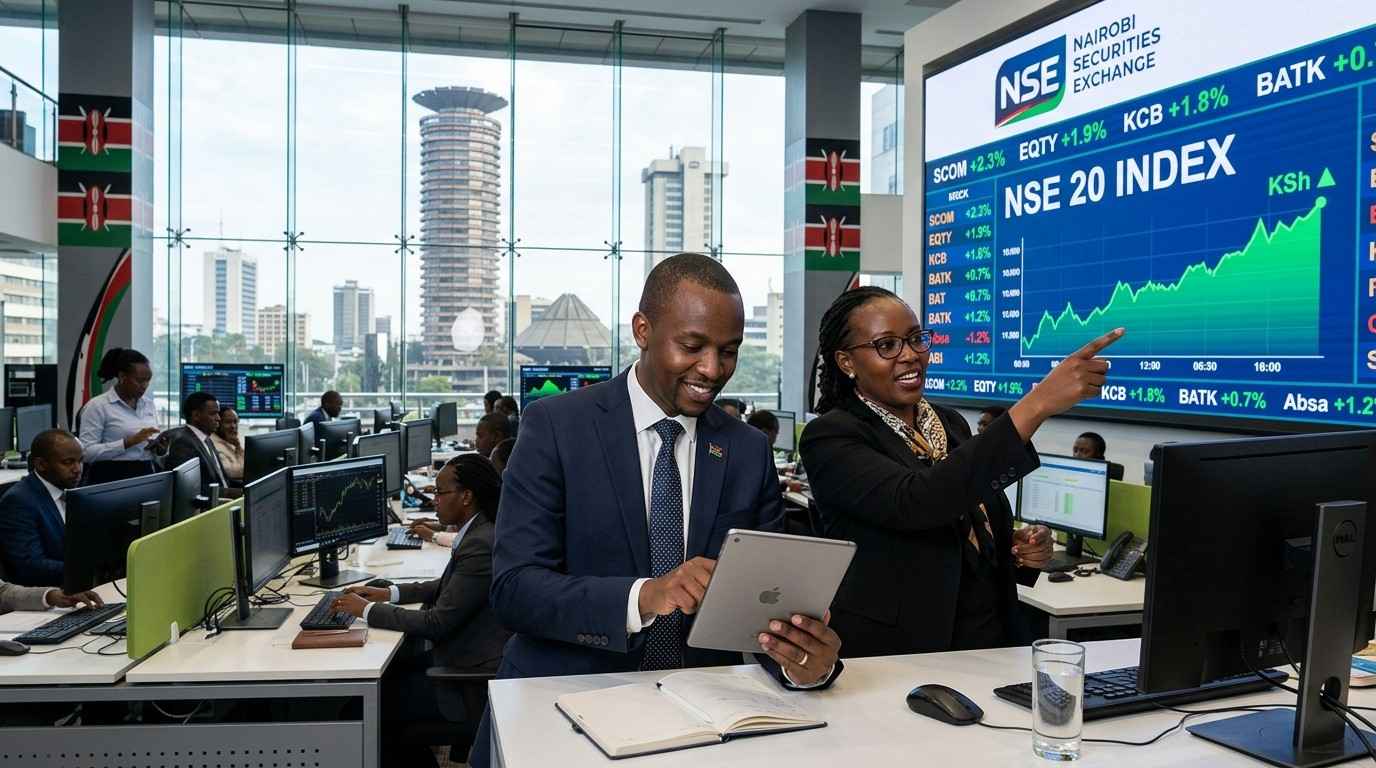
The Nairobi Securities Exchange (NSE) is Kenya's official stock market — open to all Kenyans with a CDS account.
🔰 Getting Started — How to Begin Investing in Kenya
The biggest barrier to investing is not money — it is information. Most Kenyans who delay investing do so because they believe they need a lot of money or special connections. Neither is true. Here are the answers to every beginner question.
How do I start investing in Kenya?
Start by choosing your investment type based on your budget and goals. There are three easy entry points for beginners:
1. Money Market Fund (MMF) — Open an account with a licensed fund manager like CIC, Sanlam, or NCBA. You can start with as little as Ksh 100. Your money earns daily interest.
2. NSE Shares — Open a CDS account with a CMA-licensed stockbroker like Faida Investment Bank. Deposit money via M-Pesa and buy your first share. As of August 2025, you can buy just one share of any listed company.
3. Treasury Bills — Apply through the Central Bank of Kenya's DhowCSD portal. Minimum is Ksh 50,000. Returns are guaranteed by the government.
The rule: start now, start small, and add money consistently. Time in the market beats timing the market.
What is the best investment for beginners in Kenya?
A Money Market Fund is the best starting investment for most Kenyan beginners. Here is why:
- You can start with as little as Ksh 100
- Your money earns interest every day
- You can withdraw at any time
- The risk of losing money is very low
- It teaches you the habit of saving and investing
Once you have built an emergency fund of 3–6 months' expenses in an MMF, move to NSE shares for higher long-term returns.
How much money do I need to start investing in Kenya?
You need as little as Ksh 100 to start investing in Kenya. Here is a breakdown by investment type:
| Investment Type | Minimum Amount |
|---|---|
| Money Market Fund (e.g. CIC) | Ksh 100 – 1,000 |
| NSE Shares (1 share) | From ~Ksh 5 (cheapest shares) |
| Treasury Bills | Ksh 50,000 |
| Treasury Bonds | Ksh 50,000 |
| SACCO | From Ksh 500/month |
| Land (cheapest) | Ksh 50,000+ (rural plots) |
The amount matters less than the habit. Start with whatever you have.
Can I invest with Ksh 1,000?
Yes, absolutely. Ksh 1,000 is enough to:
- Open and fund a Money Market Fund account
- Buy several shares of affordable NSE companies
- Make your first SACCO contribution
Ksh 1,000 invested every month for 20 years, earning a 10% annual return, grows to over Ksh 765,000. The key is starting.
Can I invest with Ksh 5,000?
Ksh 5,000 opens many more doors. You can open a proper NSE brokerage account, buy shares in multiple companies, or split the money between an MMF (Ksh 2,000) and NSE shares (Ksh 3,000). Ksh 5,000 is a genuinely comfortable entry point for most investments except Treasury Bills.
What are the safest investments in Kenya?
Ranked from safest to riskiest:
- Treasury Bills / Bonds — Government-backed, zero default risk
- Money Market Funds — Very low risk, CMA-regulated
- SACCO savings — SASRA-regulated, dividend income
- NSE Blue-chip shares — Regulated, liquid, long-term growth
- Real estate — Safe long term, but illiquid
- Business — High potential, higher risk
Anything offering guaranteed monthly returns of 20%+ with no CMA licence is a scam. Avoid it completely.
Can students invest in Kenya?
Yes! Any Kenyan aged 18 or above with a national ID can invest. Students can start with a Money Market Fund using just Ksh 100. Many universities near Nairobi also have student SACCO chapters. Starting early is the single most powerful advantage any young Kenyan investor can have — compound interest rewards patience enormously.
Can unemployed people invest in Kenya?
Yes, if you have any income at all — casual work, small business, family support, or savings. You do not need a formal salary to invest. A Money Market Fund accepts Ksh 100. Even contributing Ksh 200–500 whenever possible builds a habit and a growing balance.
What investment can I start with a small salary?
If your salary is between Ksh 15,000 and Ksh 40,000 per month, a practical starting plan is: save 10–20% of every paycheck. Put it in an MMF first. Once you have Ksh 10,000 saved, begin buying NSE shares monthly. Join your employer SACCO if one is available — many offer soft loans against your savings, which is a huge benefit.
📈 NSE & Shares — Everything You Need to Know
The Nairobi Securities Exchange (NSE) is Kenya's official stock market where you can buy and sell shares of listed companies like Safaricom, Equity Bank, KCB, and more than 60 others. Here are the most common questions about shares in Kenya.
How do I buy shares in Kenya?
Follow these five steps:
- Choose a CMA-licensed broker — such as Faida Investment Bank
- Register online — upload your national ID, KRA PIN, and passport photo
- Get your CDS account — created automatically by your broker
- Deposit funds — via M-Pesa or bank transfer
- Place a buy order — during NSE trading hours: 9:00 AM – 3:00 PM, Mon–Fri
Read our full guide: How to Buy Shares in Kenya: Step-by-Step Guide (2026)
How do I open a CDS account?
A CDS (Central Depository System) account is where your shares are stored electronically. You do not need to apply separately — when you register with a CMA-licensed broker like Faida Investment Bank, they open a CDS account for you automatically as part of the sign-up process. You need your national ID, KRA PIN, and a passport-size photo.
Which stockbroker is best in Kenya?
Faida Investment Bank is one of the most trusted CMA-licensed stockbrokers in Kenya for both beginners and experienced investors. Key advantages:
- CMA-regulated and NSE-regulated
- M-Pesa funding supported
- Fast digital account opening
- CDS account included automatically
- Professional investment advisory
Other reputable options include NCBA Securities and Dyer & Blair. Always confirm CMA licensing at www.cma.or.ke.
Faida Investment Bank
Buy and sell shares on the Nairobi Securities Exchange with one of Kenya's most trusted CMA-licensed brokers. Your CDS account is included. Fund via M-Pesa. Start with as little as one share.
Open Account at Faida →Which shares should I buy in Kenya?
For beginners, the safest starting point is blue-chip stocks — large, profitable companies with a long track record. Top picks in 2026:
- Safaricom (SCOM) — Kenya's largest company, strong dividends (Ksh 2.00/share in 2026)
- Equity Group (EQTY) — Ksh 5.75/share dividend in 2025, pan-Africa growth
- KCB Group (KCB) — Ksh 7.00/share dividend, deep undervaluation signals
- Co-operative Bank (COOP) — 8.3% dividend yield
- Standard Chartered Kenya (SCBK) — 13.34% dividend yield
See our detailed analysis: 10 Best Shares to Buy Today in Kenya (2026)
What are the cheapest shares on the NSE?
Some NSE shares trade at very low prices (under Ksh 5 per share), making them accessible even with Ksh 100. However, a low price does not mean a good deal — always check the company's financial health before buying. A cheap share in a struggling company is a bad investment regardless of price. Focus on value, not just price.
Which stocks pay the highest dividends in Kenya?
Based on 2025–2026 NSE data, the highest dividend yielding stocks are:
| Company | Dividend Yield (approx.) |
|---|---|
| Standard Chartered Kenya (SCBK) | 13.34% |
| BAT Kenya (BATK) | ~12% |
| Co-operative Bank (COOP) | ~8.3% |
| Equity Group (EQTY) | ~7% |
| Safaricom (SCOM) | ~6.6% |
| KCB Group (KCB) | ~5% |
Is Safaricom a good investment?
Yes — Safaricom is widely considered Kenya's best blue-chip stock. It holds ~1/3 of the NSE's total market cap, pays consistent dividends (Ksh 2.00/share in 2026, a record high), and its M-Pesa platform keeps growing. The Ethiopian venture is adding near-term costs but represents enormous long-term upside. For patient, long-term investors, SCOM is a core holding.
Read our analysis: Safaricom Stock: Don't Buy Until You Analyze the Right Way
How often are dividends paid on the NSE?
Most NSE companies pay dividends once a year, usually between March and June after releasing their annual results. Some companies — like Equity Bank — pay an interim dividend mid-year and a final dividend after year-end, giving investors two payouts annually. To receive dividends, you must own shares on or before the announced book closure date.
How do I sell shares in Kenya?
Log in to your broker's trading platform, select the shares you want to sell, enter the quantity and your asking price, and submit the sell order. Your broker executes the order during NSE trading hours (9:00 AM – 3:00 PM). Settlement takes T+3 business days (money reaches your account 3 days after the sale date).
Can I lose all my money in shares?
In theory, if a company you invest in collapses completely, you could lose the money invested in that company. However, you cannot lose all your money if you spread across 5–10 different companies (diversification). Blue-chip NSE companies like Safaricom, Equity, and KCB are highly unlikely to collapse — they are systematically important to Kenya's economy. The biggest risk is panic-selling during market dips and locking in a loss you did not need to take.
How long should I hold shares?
The ideal holding period for most NSE blue-chip stocks is 5–20 years. Share prices bounce up and down every day, but over the long term, quality companies grow in value and pay growing dividends. Selling too early because of short-term price dips is the most common — and most costly — mistake Kenyan investors make.
💰 Passive Income from Investments in Kenya
Passive income means money that flows to you without active daily work. Investments are one of the best ways to build passive income in Kenya.
How can I earn passive income in Kenya?
The main investment-based passive income streams in Kenya:
- NSE dividends — Annual cash from shares you hold
- Money Market Fund interest — Daily interest credited to your account
- Treasury Bond coupons — Semi-annual interest from the government
- Rental income — Monthly rent from property you own
- SACCO dividends — Annual returns on SACCO savings
How much do I need to invest to earn Ksh 10,000 per month?
This depends on the investment type and return rate:
| Investment | Approx. Return | Capital Needed |
|---|---|---|
| MMF (12% p.a.) | Ksh 10,000/mo | Ksh 1,000,000 |
| NSE Dividends (6% yield) | Ksh 10,000/mo | Ksh 2,000,000 |
| T-Bonds (14% coupon) | Ksh 10,000/mo | Ksh 857,143 |
| Rental Property | Ksh 10,000/mo | Ksh 1.5M–5M property |
The path to Ksh 10,000/month is long but achievable. Start small, reinvest returns, and add monthly contributions.
How much do I need to invest to earn Ksh 50,000 per month?
To earn Ksh 50,000 per month (Ksh 600,000 per year) passively:
- At 12% MMF returns: you need Ksh 5 million invested
- At 8% NSE dividend yield: you need Ksh 7.5 million in shares
- At 14% Treasury Bond rate: you need Ksh 4.3 million
This is a long-term goal best achieved by consistent monthly investing over 10–20 years, reinvesting dividends, and letting compound interest do the heavy lifting.
Can dividends replace a salary in Kenya?
Yes — but it takes years of disciplined investing. To replace a Ksh 80,000 monthly salary with NSE dividends, you would need roughly Ksh 8–16 million invested in dividend stocks, depending on yield. This is achievable for Kenyans who start early, invest consistently, and reinvest dividends for 15–25 years rather than spending them.
🏦 Money Market Funds (MMFs) — All Your Questions Answered
What is a Money Market Fund?
A Money Market Fund (MMF) is a pooled investment account run by a licensed fund manager. Hundreds or thousands of investors put their money in together, and the fund manager invests it in very safe, short-term assets — mainly government Treasury Bills and fixed bank deposits. You earn a share of the returns as daily interest. Unlike a bank savings account, the interest rates on MMFs are significantly higher and update regularly based on market rates.
Which is the best MMF in Kenya?
Popular, CMA-regulated MMFs in Kenya include:
- CIC Money Market Fund — One of the most accessible, very low minimum
- NCBA Money Market Fund — Accessible via mobile banking
- Sanlam Money Market Fund — Consistently competitive rates
- Ziidi Money Market Fund (M-Pesa) — Directly integrated into M-Pesa, extremely convenient
- Co-op Trust MMF — Solid rates, Co-op Bank integration
Compare current rates on the CMA website before choosing.
Is an MMF better than a savings account?
In most cases, yes. Here is a quick comparison:
| Feature | Bank Savings Account | Money Market Fund |
|---|---|---|
| Typical Annual Return | 2–4% | 10–14% |
| Daily Interest | Usually No | Yes |
| Withdrawal Speed | Instant | Same day – 3 days |
| Minimum Balance | Ksh 0–1,000 | Ksh 100–1,000 |
| Regulated By | CBK | CMA |
The only area where a bank account wins is instant 24/7 ATM access. For savings you do not need daily, an MMF is clearly superior.
Can I lose money in an MMF?
It is extremely rare, but technically possible if the underlying investments (e.g. a bank the fund invested in) fail. In practice, CMA-regulated MMFs in Kenya have never caused retail investors to lose principal. The risk is far lower than shares. Always choose a fund regulated by the Capital Markets Authority.
MMF vs Treasury Bills: Which is better?
MMFs win on flexibility; T-Bills win on certainty.
- MMFs: Ksh 100 minimum, withdraw anytime, variable rates
- Treasury Bills: Ksh 50,000 minimum, locked for 91/182/364 days, fixed government-guaranteed rate
For emergency savings, use an MMF. For money you will not need for 91 days+, T-Bills often offer slightly better or comparable rates with zero credit risk.
💵 Treasury Bills & Treasury Bonds
What are Treasury Bills in Kenya?
Treasury Bills (T-Bills) are short-term loans you give to the Kenyan government. In return, the government pays you interest and gives your money back at the end of the term. T-Bills come in three durations:
- 91-day T-Bill (~3 months)
- 182-day T-Bill (~6 months)
- 364-day T-Bill (~1 year)
They are auctioned every week by the Central Bank of Kenya (CBK). They are one of the safest investments in the country.
How do I buy Treasury Bills in Kenya?
Three ways to buy T-Bills:
- CBK DhowCSD Portal — Visit centralbank.go.ke, register for DhowCSD, and apply directly. Most straightforward method.
- Through your bank — Many banks (Equity, KCB, Co-op) allow you to apply for T-Bills via internet banking
- Through M-Pesa / Ziidi — The Ziidi app on M-Pesa now gives access to some government securities
Minimum investment: Ksh 50,000. Interest is paid upfront (discounted).
Treasury Bills vs Bonds: What is the difference?
| Feature | Treasury Bills | Treasury Bonds |
|---|---|---|
| Duration | 91, 182, or 364 days | 2, 5, 10, 15, 20, 25 years |
| Interest Payment | Upfront (discounted) | Every 6 months (coupon) |
| Return Rate | ~12–16% p.a. | ~13–16% p.a. |
| Minimum | Ksh 50,000 | Ksh 50,000 |
| Best For | Short-term savings | Long-term income |
Both are government-guaranteed and extremely safe. Choose T-Bills if you might need your money back within a year. Choose Bonds if you want regular income for many years.
🏠 Real Estate — Land, Rental Property & Property Investment
Is land a good investment in Kenya?
Land is one of the most popular investments in Kenya — and for good reason. Land prices in most Kenyan towns have appreciated significantly over the past 20 years, especially in areas like Kiambu, Kajiado, Machakos, and the outskirts of major cities. However, land has some important disadvantages: it is illiquid (hard to sell quickly), you earn no income while you hold it, and buying and selling involves high transaction costs (stamp duty, legal fees). It is a good long-term store of value, not a short-term investment.
Should I buy land or shares?
It depends on your situation:
- Buy shares if: you have small capital (under Ksh 500,000), want flexibility, or need your money to grow now
- Buy land if: you have Ksh 500,000+, have a long time horizon (10+ years), and do not need the money to generate income right away
The smartest investors do both — shares for liquidity and growth, land for long-term capital preservation.
How much can rental property earn in Kenya?
Rental yield in Kenya's major towns typically ranges from 5–10% per year on the property value. For example, a Ksh 3 million rental apartment in Nairobi might rent for Ksh 15,000–25,000 per month, giving a yield of 6–10%. Yields vary widely by location, property type, and management quality. Factor in maintenance costs, vacancy periods, and agency fees before calculating returns.
What are the risks of investing in land in Kenya?
Key risks of land investment in Kenya:
- Fraud — Fake title deeds are common. Always verify at the lands registry
- Double allocation — One plot sold to multiple buyers. Use a licensed conveyancing lawyer
- Delayed appreciation — Land in the wrong area can sit idle for years with no value growth
- Squatters / encroachment — Unvisited land can be occupied illegally
- High transaction costs — Stamp duty, legal fees, and search fees add up
Rule: Never buy land without visiting it, verifying the title at the Ministry of Lands, and using a qualified conveyancing advocate.
🏆 Wealth Building — How to Grow Rich Through Investing
What is compound interest and why does it matter?
Compound interest means you earn interest on your interest. Example: You invest Ksh 100,000 in an MMF at 12% per year. After year 1, you have Ksh 112,000. In year 2, you earn 12% on Ksh 112,000 — not just the original Ksh 100,000. Over 20 years at 12%, your Ksh 100,000 becomes over Ksh 964,000 — without adding another shilling. This is why starting early is the single most powerful investment decision you will ever make.
How long does it take to build wealth through investing?
Real wealth-building through investing takes 10–30 years of consistent discipline. Here is a realistic timeline for someone investing Ksh 5,000 per month at 12% annual returns:
| Years Invested | Total Deposited | Portfolio Value |
|---|---|---|
| 5 years | Ksh 300,000 | Ksh 410,000 |
| 10 years | Ksh 600,000 | Ksh 1,155,000 |
| 20 years | Ksh 1,200,000 | Ksh 4,994,000 |
| 30 years | Ksh 1,800,000 | Ksh 17,531,000 |
Starting at age 25 and investing Ksh 5,000/month means you could have Ksh 17.5 million by age 55 — a comfortable retirement fund.
How much should I invest every month?
A commonly recommended rule is the 50/30/20 budget: spend 50% on needs, 30% on wants, and invest 20% of your income. If your salary is Ksh 50,000, aim to invest Ksh 10,000 monthly. Even Ksh 2,000–5,000 per month, invested consistently over 20+ years, grows into serious wealth. The amount matters less than the consistency.
What is the best age to start investing?
Now. Whatever age you are reading this, that is the best age. But to be specific: starting at 20–25 gives you the maximum benefit of compound interest. Every year you delay costs you significantly — waiting from age 25 to age 35 to start investing can literally halve your final wealth, even if you invest the same monthly amount for the same number of years.
Should I invest monthly or save first?
Both — simultaneously. Build an emergency fund equal to 3–6 months of your expenses in an MMF (not a savings account that earns nothing). At the same time, invest whatever you can afford into NSE shares or T-Bills. You do not need to finish saving before you start investing. The two goals can and should run in parallel.
📊 Investment Comparisons — Which Is Better?
| Comparison | Better For... | Winner (Generally) |
|---|---|---|
| Shares vs MMF | Long-term wealth vs low-risk savings | Both — use MMF first, shares for growth |
| Shares vs Land | Liquidity vs store of value | Shares for income; land for long-term hold |
| Shares vs T-Bills | High returns vs safety | Shares long-term; T-Bills for short-term idle cash |
| MMF vs Fixed Deposit | Flexibility vs bank security | MMF (higher rates + more flexible) |
| Stocks vs SACCO | Market returns vs member benefits | Both — SACCO for loans; stocks for growth |
| Stocks vs Crypto | Regulated vs speculative | Stocks (regulated, fundamental value) |
| Stocks vs Business | Passive vs active income | Depends on your skills and time |
| Land vs Rental Property | Appreciation vs income | Rental property (generates cash flow) |
| Dividend vs Growth Stocks | Income now vs capital later | Dividend stocks for income; both over time |
⚠️ Risk & Safety — Protecting Your Money
How do I avoid investment scams in Kenya?
Red flags that signal a scam:
- Guaranteed returns of 20%+ per month
- Pressure to invest immediately or lose the offer
- No CMA, CBK, or IRA licence number provided
- Returns paid from new investor money (Ponzi structure)
- No physical office address or audited accounts
Always verify any investment firm at www.cma.or.ke. If it is not on the CMA register, it is illegal and likely a scam.
Is investing better than saving?
For money you will not need for more than 6 months — yes, investing is better than saving in a low-interest bank account. Kenyan bank savings accounts typically offer 2–4% interest, which barely keeps up with inflation (~4–6%). An MMF at 12% or NSE shares averaging 15–20% long-term returns will grow your money far faster. Save for emergencies; invest for goals.
What happens during a stock market crash?
During a market crash, share prices fall sharply. If you need the money immediately, this is a problem. But if you are a long-term investor, a crash is actually an opportunity — you can buy quality shares at cheaper prices. The NSE has recovered from every crash in its history. Kenyan blue-chip companies like Safaricom, Equity, and KCB survived the 2008 global crisis, the 2020 COVID crash, and many other downturns — and their share prices eventually reached new all-time highs.
How can I reduce investment risk?
Five ways to reduce investment risk in Kenya:
- Diversify — Spread across sectors (banking, telecoms, manufacturing)
- Don't panic sell — Stay calm during market drops
- Only invest regulated products — CMA/CBK-licensed only
- Emergency fund first — 3–6 months of expenses in an MMF before investing in shares
- Think long term — The longer your horizon, the less day-to-day risk matters
🎯 How to Invest by Budget — From Ksh 1,000 to Ksh 500,000
Where should I invest Ksh 1,000?
Put it in a Money Market Fund. At 12% annual returns, Ksh 1,000 earns about Ksh 3.28 per day. Small — but it builds the habit. Add to it every week or month.
Where should I invest Ksh 5,000?
Split it: Ksh 2,000 in an MMF (emergency base) and Ksh 3,000 to buy your first shares on the NSE via Faida Investment Bank. You can buy several shares of affordable companies for Ksh 3,000.
Where should I invest Ksh 10,000?
A strong allocation: Ksh 5,000 in an MMF, Ksh 5,000 split across 2–3 NSE shares in different sectors (e.g. banking + telecom). Alternatively, start with all in an MMF and buy NSE shares gradually as the MMF grows.
Where should I invest Ksh 50,000?
At Ksh 50,000 you have serious options: Ksh 20,000 in MMF, Ksh 30,000 in NSE shares — or go straight into a 91-day Treasury Bill via the CBK DhowCSD portal at the full Ksh 50,000 minimum. T-Bills are especially attractive at this amount because the guaranteed government rate beats most MMFs.
Where should I invest Ksh 100,000?
A well-rounded allocation: Ksh 50,000 in Treasury Bills (1-year), Ksh 30,000 in 3–4 NSE blue-chip stocks, Ksh 20,000 in an MMF as liquid reserve. This balances safety, growth, and access.
Where should I invest Ksh 500,000?
At this level, diversification is critical. Consider: Ksh 150,000 in Treasury Bonds (for long-term income), Ksh 200,000 in NSE blue-chip stocks (diversified across banking, telecom, energy), Ksh 100,000 in a Money Market Fund (liquidity), and Ksh 50,000 as a property down-payment saving. Consult a CMA-licensed financial advisor for personalised guidance.
How should I invest my first salary?
The first salary plan that sets you up for life:
- Pay yourself first — set aside 20% before spending anything
- Open an MMF and put at least half of your savings there
- Join your employer's SACCO if available
- When you have 3 months of expenses saved, start buying NSE shares monthly
📱 Technology & Investing in Kenya
Can I invest using M-PESA?
Yes — M-Pesa is now deeply connected to investing in Kenya:
- Ziidi Money Market Fund — Save and earn interest directly in M-Pesa
- Ziidi Trader — Buy NSE shares directly from the M-Pesa app
- Fund your broker — Most NSE brokers (including Faida Investment Bank) accept M-Pesa deposits
- T-Bills — The CBK's DhowCSD portal is accessible from any mobile browser
Which app is best for investing in Kenya?
Top investing apps for Kenyan investors:
- M-Pesa / Ziidi — Best for MMF and stock beginners
- Faida Investment Bank App — Best for full NSE trading
- CBK DhowCSD Portal — Best for Treasury Bills and Bonds
- Your bank's app — Many banks now offer T-Bill subscriptions and fixed deposits in-app
How do I track my investments?
For NSE shares, log in to your broker's platform to see your portfolio value, dividends received, and transaction history. Your CDS statement (available from the CDSC portal) shows all shares held in your name. For MMFs, the fund manager's app or portal shows your balance and daily interest. For T-Bills, the CBK DhowCSD portal tracks your holdings and maturity dates. A simple spreadsheet (Excel or Google Sheets) works well for tracking your total net worth across all investments.
👨🎓 Questions Young Kenyans Ask About Investing
What investments are best for university students?
University students should start with:
- MMF — Any spare cash earns daily interest. No lock-in.
- NSE shares — Start with 1 share of a blue-chip company. The NSE removed the 100-share minimum in August 2025.
- Student SACCO — Many universities have SACCOs offering soft loans and dividends
The most valuable thing a university student can invest in is financial education. Read company annual reports, follow the NSE, and understand how markets work before putting large sums in.
How can Gen Z start investing in Kenya?
Gen Z has one massive advantage: time. Even Ksh 500 per month invested at age 20 at 12% annual returns becomes Ksh 3.2 million by age 55. Steps for Gen Z:
- Open a Ziidi MMF on M-Pesa today
- Learn how the NSE works (free via the NSE website)
- Open a Faida Investment Bank account when you are ready for stocks
- Invest monthly — no matter how small
- Never invest in unregulated "investment groups" on WhatsApp or Facebook
How do I build wealth before 30 in Kenya?
A practical action plan for building wealth before 30 in Kenya:
- Live below your means — avoid lifestyle inflation from your first salary
- Invest 20%+ of every paycheck consistently, starting from your first job
- Avoid debt for anything that loses value (cars, electronics, clothes)
- Build multiple income streams — freelance, side hustle, investments
- Reinvest all dividends instead of spending them
- Track your net worth quarterly
The Kenyans who build real wealth before 30 are not the highest earners — they are the most disciplined spenders and the most consistent investors.
What should I invest in during my 20s in Kenya?
In your 20s, you have time on your side — which means you can afford more risk for higher potential returns. Best investments for your 20s:
- NSE growth stocks — KCB, Equity, Safaricom — hold for 10–20 years
- Money Market Fund — Build your emergency fund and short-term goals
- Skills investment — A professional certification or tech skill can increase your income faster than any stock market investment at this stage
- SACCO membership — Join early for cheap loan access later
💻 Laptop Deals in Nairobi — Quality at Honest Prices
Whether you are a student, freelancer, or professional — we stock reliable laptops at the best prices in Nairobi. Call or WhatsApp us for current stock and pricing. While stock lasts.
📞 Call / WhatsApp: 0714 701 814📚 Related Reading on KE Offers
- How to Buy Shares in Kenya: Step-by-Step Guide (2026)
- 10 Best Shares to Buy Today in Kenya (2026)
- Safaricom Stock: Don't Buy Until You Analyze It the Right Way
- Safaricom Dividend History: Full Payout Record (2009–2026)
- Equity Bank Dividend: Full Payout History & How to Invest
- How to Spot Overvalued vs Undervalued Stocks in Kenya
- How the Central Bank of Kenya Influences Your Everyday Life