Safaricom Dividend Payout: How Much Investors Earn
The Safaricom dividend payout has grown from just Ksh 0.10 per share in 2009 to a record Ksh 2.00 in 2026 — making SCOM one of the most rewarding dividend stocks on the Nairobi Securities Exchange. This guide breaks down every payout since the company listed, explains the dips, and tells you what the numbers mean for your wallet.
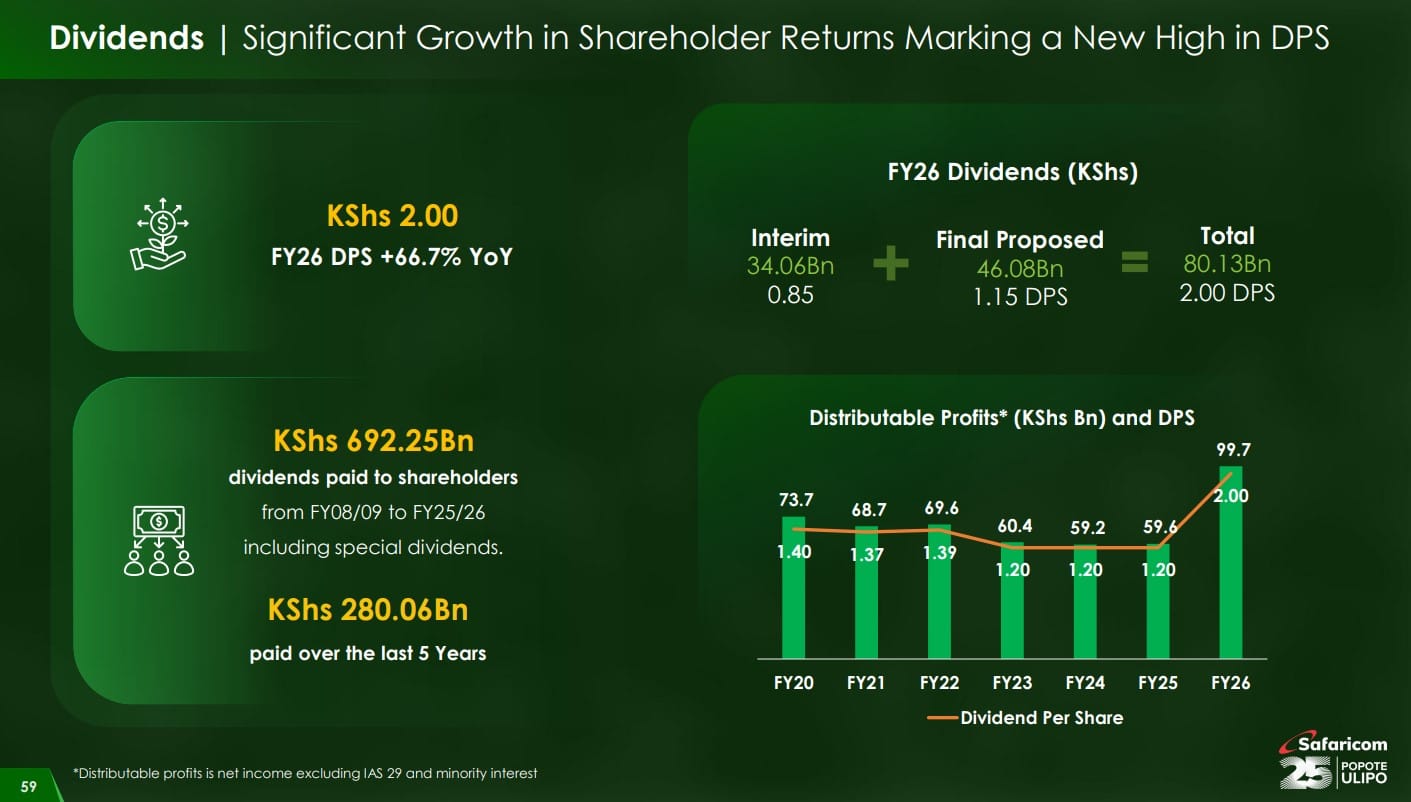
Safaricom PLC (SCOM) has paid a dividend every year since 2009. The 2026 payout of Ksh 2.00 per share is a record high. | Source: Safaricom Annual Reports
Safaricom dividend payout in 2026 is Ksh 2.00 per share — the highest ever paid by the company. Since 2009, Safaricom has raised its dividend from Ksh 0.10 to Ksh 2.00, a 20× increase over 17 years. The company pays dividends twice a year: an interim payout around November and a final dividend around July.
What Is the Safaricom Dividend and Why Should You Care?
The Safaricom dividend is the cash that Safaricom PLC pays to people who own its shares — and in 2026, that payment hit a record high of Ksh 2.00 per share. If you bought 10,000 Safaricom shares on the Nairobi Securities Exchange (NSE), Safaricom would send you Ksh 20,000 in dividends this year, just for holding the shares.
Dividends are one of the two main ways you make money from shares. The first way is if the share price goes up (capital gain). The second way is dividends — the company shares a slice of its profits with you. Safaricom has been doing this every single year since 2009, and the amounts have climbed almost every year.
This matters for Kenyan investors because Safaricom (ticker: SCOM) is the biggest company on the NSE, with a market cap of over Ksh 1.34 trillion. When Safaricom sneezes, the whole NSE feels it. Understanding its dividend history helps you know whether SCOM is paying you fairly, and whether now is a good time to invest.
Safaricom Dividend Per Share: Full History 2009–2026
The table below shows every Safaricom dividend since 2009, the year-on-year change, and a link to the official annual report for that year. All figures are in Kenya shillings (Ksh) per ordinary share.
| Financial Year | Dividend Per Share | Change vs Prior Year | Official Source |
|---|---|---|---|
| 2009 | Ksh 0.10 | — (first year) | 2009 Annual Report ↗ |
| 2010 | Ksh 0.20 | ▲ +100% | 2010 Annual Report ↗ |
| 2011 | Ksh 0.20 | = Unchanged | 2011 Annual Report ↗ |
| 2012 | Ksh 0.22 | ▲ +10% | 2012 Annual Report ↗ |
| 2013 | Ksh 0.31 | ▲ +41% | 2013 Annual Report ↗ |
| 2014 | Ksh 0.47 | ▲ +52% | 2014 Annual Report ↗ |
| 2015 | Ksh 0.64 | ▲ +36% | 2015 Annual Report ↗ |
| 2016 | Ksh 0.76 | ▲ +19% | 2016 Annual Report ↗ |
| 2017 | Ksh 0.97 | ▲ +28% | 2017 Annual Report ↗ |
| 2018 | Ksh 1.10 | ▲ +13% | 2018 Annual Report ↗ |
| 2019 | Ksh 1.25 | ▲ +14% | 2019 Annual Report ↗ |
| 2020 | Ksh 1.40 | ▲ +12% | 2020 Annual Report ↗ |
| 2021 | Ksh 1.37 Dip | ▼ −2.1% | 2021 Annual Report ↗ |
| 2022 | Ksh 1.39 | ▲ +1.5% | — |
| 2023 | Ksh 1.20 Dip | ▼ −13.7% | 2023 Annual Report ↗ |
| 2024 | Ksh 1.20 | = Unchanged | 2024 Annual Report ↗ |
| 2025 | Ksh 1.20 | = Unchanged | 2025 Annual Report ↗ |
| 2026 | Ksh 2.00 Record | ▲ +66.7% | FY26 Investor Presentation ↗ |
The Growth Story: From 10 Cents to 2 Shillings
In 2009, Safaricom paid just 10 cents per share. Most investors didn't even notice — it felt like a token gesture. But something big was happening underneath. M-Pesa was taking off. Data revenues were growing. People were using their phones in entirely new ways.
Between 2009 and 2020, the Safaricom dividend grew every single year — sometimes doubling in a single year (2010), sometimes more modestly (2018 and 2019). By 2020, the payout had reached Ksh 1.40 per share. A person who had bought 100,000 shares at the 2009 IPO for Ksh 5 per share and simply held them would have collected well over Ksh 100,000 in dividends alone by 2020 — not counting the rise in share price.
The 2013–2015 period was especially rewarding. The dividend rose from Ksh 0.31 to Ksh 0.64 in just two years — a 106% jump. That era saw Safaricom's voice revenue still growing strongly while M-Pesa was starting to generate serious money. Mobile data was also picking up, as the number of Kenyans with smartphones grew fast.
Why Did the Dividend Drop in 2021 and 2023?
Two things broke Safaricom's winning streak — and both of them share the same address: Addis Ababa, Ethiopia.
The 2021 Dip: A Small Stumble
In 2021, the dividend fell slightly from Ksh 1.40 to Ksh 1.37 — a drop of just 3 cents per share. On the surface, this might look minor, but it was the first time Safaricom had ever cut its dividend. The reason was that Safaricom was preparing for a massive investment: launching mobile network services in Ethiopia, Africa's second-most-populated country. Setting up a mobile network from scratch costs billions of shillings. Safaricom needed to save cash.
The 2023 Dip: The Ethiopia Hangover
The bigger drop came in 2023. The dividend fell from Ksh 1.39 in 2022 to Ksh 1.20 — a cut of nearly 14%. By this time, the Ethiopian operation was fully live, but it was losing money. Ethio Telecom, the state-owned competitor, was massive and deeply embedded. Getting Kenyans in Addis Ababa to switch to a new network took time. Meanwhile, Safaricom Kenya was still paying out for the Ethiopian build-out. Profits took a hit, and the dividend followed.
The dividend then stayed flat at Ksh 1.20 for three consecutive years: 2023, 2024, and 2025. Some investors were frustrated. But patient ones understood that this was a company absorbing a huge cost now to earn bigger rewards later.
The 2026 Record: Why Did Safaricom Jump to Ksh 2.00?
The 2026 Safaricom dividend of Ksh 2.00 per share is not just a record high — it is a stunning 66.7% jump from the Ksh 1.20 paid in 2023, 2024, and 2025. What changed?
Several things clicked into place at once. The Ethiopian operation moved closer to profitability. M-Pesa — which now includes savings (Ziidi Money Market Fund), lending, merchant payments, and even direct NSE stock trading through the Ziidi Trader platform — became an even bigger money machine. By FY26, Safaricom's earnings per share (EPS) grew by nearly 48% year-on-year, one of the strongest results in the company's history.
With more than 40 billion shares in issue, a Ksh 2.00 per share dividend means Safaricom paid out over Ksh 80 billion in total dividends in 2026. That is an enormous amount of money flowing back to Kenyan shareholders — including the Kenyan government, Vodacom, and hundreds of thousands of ordinary Kenyans who own SCOM shares through the NSE.
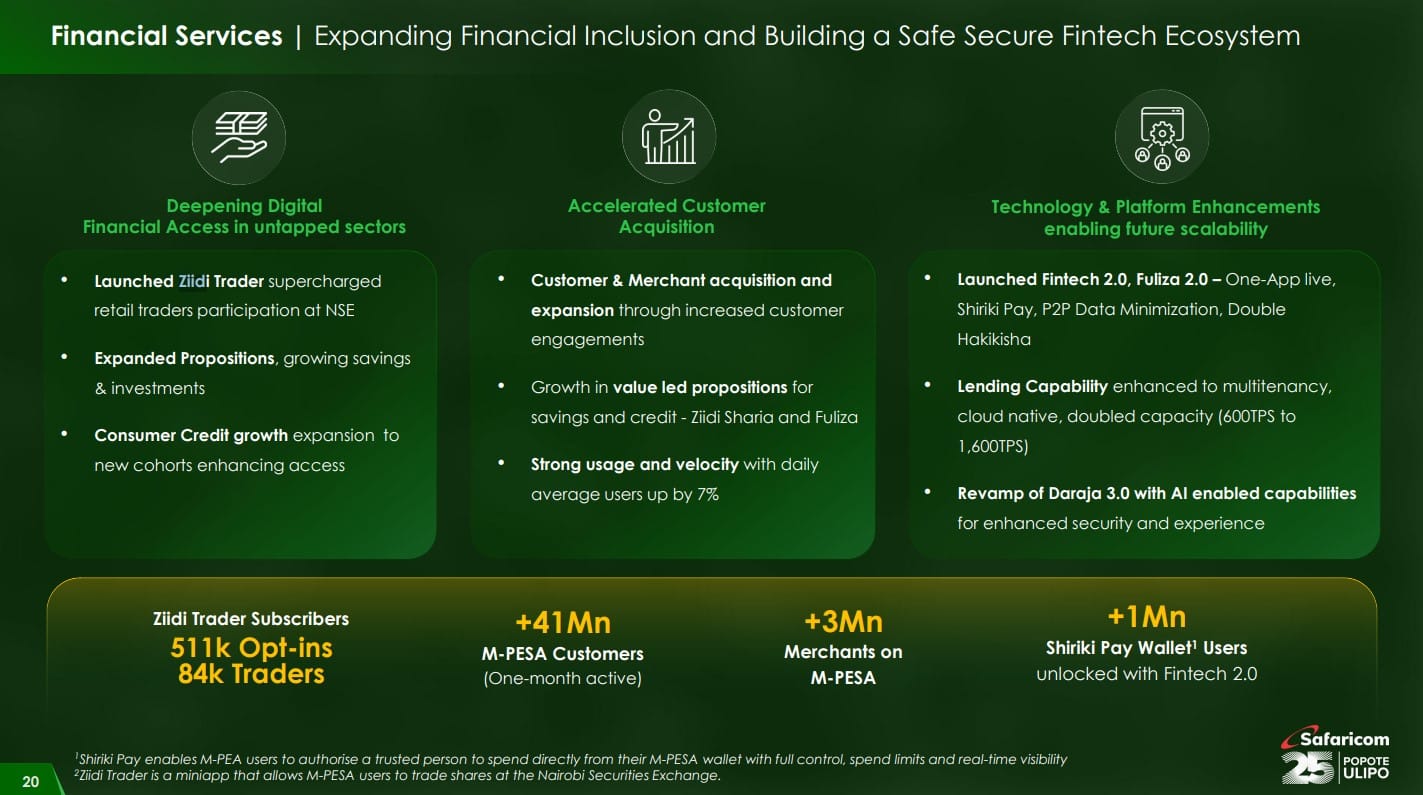
M-Pesa's expanding ecosystem — from mobile money to the Ziidi Trader stock platform — has been the main engine of Safaricom's rising profits and dividends. | Photo: Safaricom PLC
How to Calculate Your Safaricom Dividend Payout
It is very simple. Multiply the number of shares you own by the dividend per share for that year.
Example (2026): You own 5,000 Safaricom shares × Ksh 2.00 = Ksh 10,000 in dividends.
Example (2009): Same 5,000 shares × Ksh 0.10 = Ksh 500 in dividends. The difference 17 years later is 20 times bigger.
Remember that Safaricom pays dividends in two rounds each year. An interim dividend is paid around November (after the half-year results in October). The final dividend is paid around July (after the full-year results in May). When Safaricom announces "Ksh 2.00 per share" for FY26, that Ksh 2.00 is split across both payments.
Who Gets the Dividend?
Only shareholders who appear on the Safaricom share register on the record date — a specific cut-off date announced by the company — receive the dividend. If you buy Safaricom shares after the record date, you will miss that round of dividends and wait for the next one. This is called "going ex-dividend." You can track record dates on the Nairobi Securities Exchange website or on your stockbroker's platform.
What Is Safaricom's Dividend Yield?
Dividend yield tells you how much you earn in dividends compared to what you paid for the share. It is calculated as:
If Safaricom trades at around Ksh 30.20 per share and pays Ksh 2.00 in dividends in 2026, the dividend yield is roughly 6.6% — paid on top of any rise in the share price.
A 6.6% yield is solid for a Kenyan blue-chip stock. It is lower than some NSE banking stocks that pay 8–13% yields, but Safaricom's yield comes with far stronger earnings momentum — EPS grew 48% in FY26 — and a dominant market position that no other Kenyan company can match.
For investors who want to understand more about how to compare yields and valuation, see our guide on how to spot overvalued vs undervalued stocks in Kenya.
Who Are the Biggest Beneficiaries of the Safaricom Dividend?
Safaricom has about 40.07 billion shares in issue. The biggest shareholders are:
- Vodacom Group (via Vodafone) — approximately 35% of shares, making them the single largest private shareholder
- The Government of Kenya — about 35%, meaning a large portion of Safaricom dividends flows directly into the Kenyan Treasury
- Free float (retail and institutional Kenyans) — the remaining roughly 30%, spread across pension funds, SACCOs, and individual investors on the NSE
This means that when Safaricom declares a big dividend, a significant chunk goes to ordinary Kenyan investors — people who bought shares through their stockbroker, or through pension funds like the NSSF that invest in NSE stocks.
How to Start Earning Safaricom Dividends
To receive Safaricom dividends, you need to own shares in the company. Here is how to do it in Kenya:
Step 1: Choose a Licensed Stockbroker — and Get Your CDS Account Free
You cannot buy NSE shares directly — you must go through a licensed stockbroker. The good news is that when you sign up with a broker, they open your Central Depository System (CDS) account for you as part of the process. A CDS account is where your shares are stored electronically — think of it as a digital safe for your Safaricom shares. You do not need to open one separately.
Our top recommended broker for Kenyan retail investors is Faida Investment Bank. When you register with Faida, your CDS account is opened automatically — no extra trips to a bank, no separate paperwork. You get a single, streamlined account that lets you buy and sell NSE shares, receive dividends, and track your portfolio all in one place.
Investment
Bank
Faida Investment Bank
NSE-Licensed Stockbroker & Investment Bank — Trusted by Thousands of Kenyan Investors
- ✅ CDS account opened automatically when you register — no separate application
- ✅ Buy & sell all NSE-listed shares including Safaricom (SCOM)
- ✅ Access to professional investment advisory
- ✅ Supports single-unit share purchases (from just 1 share)
- ✅ Dividends paid directly to your linked bank account or M-Pesa
Step 2: Fund Your Account and Place Your Order
Once your Faida account and CDS account are active, deposit funds and place a buy order for Safaricom shares through your broker. Safaricom also offers M-Pesa users a direct route via the Ziidi Trader platform — available through the M-Pesa app — though going through a full-service investment bank like Faida gives you broader market access and advisory support.
Step 3: Buy as Little as 1 Safaricom Share
Great news for first-time investors: since August 8, 2025, the NSE allows you to buy shares in multiples of just one (1) unit — down from the old minimum of 100 shares. This change was announced by the NSE in a July 29, 2025 press release and took effect on August 8, 2025, as part of the exchange's drive to grow the number of active investors to 9 million by 2029.
What this means in practice: at around Ksh 30.20 per share, you can start investing in Safaricom with as little as Ksh 30.20 — the price of a single share. With one share, your 2026 dividend would be Ksh 2.00. That is a small start, but the point is that there is now no barrier to owning a piece of Kenya's biggest company. You can buy 1 share, 10 shares, or 10,000 — the market accepts any amount. And Safaricom shares bought today may pay far more than Ksh 2.00 in dividends per share in 2030 or 2035.
For a deeper look at the investment case for Safaricom, read our full analysis on how to analyze Safaricom stock the right way.
Is Safaricom a Good Dividend Stock for Kenyan Investors?
The short answer is yes — but with some nuances worth understanding.
The Case FOR Safaricom as a Dividend Stock
- ✅ Zero missed payments in 17 years — a record no other large NSE stock can match
- ✅ Growing dividend over the long term, from Ksh 0.10 to Ksh 2.00 (+1,900%)
- ✅ Sustainable payout backed by a diverse business: voice, data, M-Pesa, fibre, cloud, Ethiopia
- ✅ Blue-chip liquidity — the most traded stock on the NSE, and since August 2025 you can buy just 1 share (from ~Ksh 30), making SCOM accessible to any Kenyan investor
- ✅ EPS growing 48% year-on-year in FY26, suggesting future dividends could keep climbing
The Case FOR Caution
- ⚠️ The Ethiopia operation is not yet fully profitable — if losses persist, the dividend could stall again
- ⚠️ Safaricom's yield of ~6.6% is lower than some NSE banking stocks (Standard Chartered Kenya pays over 13%)
- ⚠️ The company faces regulatory risk — any new telecom laws or M-Pesa taxes could affect profits
- ⚠️ A global tech slowdown or rising interest rates could make NSE dividend yields less attractive compared to Treasury Bills
Overall, Safaricom is best thought of as a dividend-growth stock rather than a pure high-yield stock. You hold it not just for today's dividend but for the expectation that Ksh 2.00 in 2026 becomes Ksh 3.00 or Ksh 4.00 in 2030. To put that in context, read our guide on the 10 best shares to buy in Kenya right now to see how SCOM compares to other NSE stocks.
Why M-Pesa Is the Secret Behind the Dividend
Many people think of Safaricom as a phone company. But the real engine of its dividends is M-Pesa, the mobile money platform that Safaricom launched in 2007. Today, M-Pesa is used by over 30 million Kenyans and processes billions of shillings in transactions every single day.
Every time someone sends money via M-Pesa, pays a bill, takes a Fuliza loan, saves with the Ziidi Money Market Fund, or buys shares through Ziidi Trader, Safaricom earns a fee. Those fees pile up into enormous profits. And those profits are what fund the dividend.
The expansion of M-Pesa into Ethiopia is why Safaricom is willing to absorb short-term losses there. If M-Pesa captures even a fraction of Ethiopia's 120 million people the way it captured Kenya's market, the dividends paid to shareholders in 2030 could look very different from what they are today.
According to Safaricom's FY26 Investor Presentation, the company now has over 2 million Ziidi Money Market Fund customers, 511,000 opt-ins to Ziidi Trader, and more than 3 million merchants in its ecosystem — all generating recurring fee income that feeds the dividend.
Frequently Asked Questions About the Safaricom Dividend
How much is the Safaricom dividend in 2026?
When does Safaricom pay dividends?
How many Safaricom shares are there?
Why did the Safaricom dividend fall in 2021 and 2023?
Do I pay tax on Safaricom dividends in Kenya?
Is the Safaricom dividend paid in M-Pesa?
What is Safaricom's total dividend payout in 2026?
Bottom Line: What the Safaricom Dividend History Tells Us
The Safaricom dividend story is really the story of Kenya's digital economy growing up. In 2009, a 10-cent dividend barely made headlines. By 2026, a Ksh 2.00 payout is generating over Ksh 80 billion for shareholders across the country. That is real money, flowing into real pockets — pension funds, SACCOs, retirement savings, and individual investors who believed in Kenya's biggest company.
The three-year pause at Ksh 1.20 tested investor patience. But the FY26 jump proved that Safaricom's management was not holding back permanently — it was building. Ethiopia, M-Pesa 2.0, 5G, fibre, Ziidi Trader: these are the engines that should keep pushing the dividend higher in the years ahead.
If you are thinking about whether to invest in Safaricom, the dividend history gives you 17 years of evidence. No missed year. No long-term stagnation. Just a company that keeps finding ways to grow and to share that growth with its shareholders. That is a rare thing on any stock exchange in the world — and it is happening right here in Kenya.
Ready to compare SCOM to other NSE opportunities? Start with our full ranking of the 10 best shares to buy in Kenya in 2026.